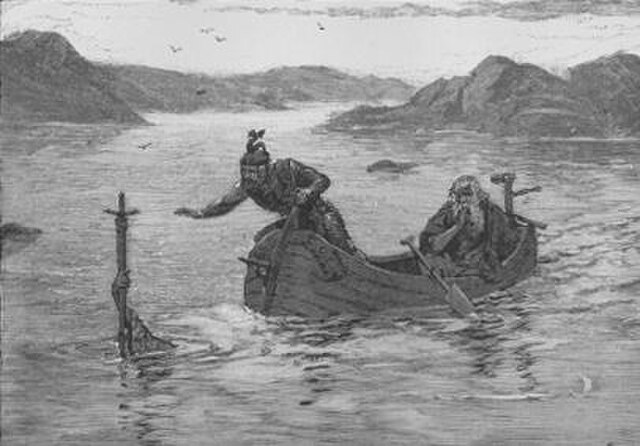
A 12th-century knight rides into a field in Tuscany, dismounts, looks to the heavens and plunges his sword straight into solid rock. Not as a test of strength. Not to impress anyone. But to give up violence forever.
Yeah. It sounds like Arthurian myth. But this wasn’t legend. This was Galgano Guidotti, a spoiled noble turned hermit who walked away from war, women, and wealth, and stabbed his blade into stone as a symbol of peace. The sword’s still there, by the way. Rusted, ancient, encased in plexiglass to protect it from tourists.
And no one can quite explain how it got there, or why it’s remained for over 840 years.
From Rich Kid to Rebel Saint
Galgano wasn’t born holy. He was, by all accounts, a bit of a jerk. The historical records from his canonization process, conducted just four years after his death, paint a picture of a young man consumed by worldly pleasures and violence.
Born in 1148 in Chiusdino, a small town in the Tuscan hills near Siena, he lived the medieval version of a trust-fund lifestyle. His father was a minor feudal lord, which meant young Galgano had money, status, and training in the art of war. He became a knight, which in that era meant he was trained to kill efficiently and expected to do so whenever his lord commanded.
Historical accounts describe him as arrogant, violent, and obsessed with martial glory. He loved horses, loved fighting, and had zero interest in spiritual matters. He was the guy at medieval parties who got drunk, started fights, and generally made everyone uncomfortable. Think of him as the 12th-century equivalent of that insufferable rich kid who thinks rules don’t apply to him.
The Visions That Changed Everything
Then, around 1180, when Galgano was 32 years old, something happened. He started having visions of the Archangel Michael, that celestial warrior often depicted with a sword, representing the archetype of the holy warrior who fights for divine justice rather than earthly glory.
At first, Galgano laughed it off. According to legend, the angel told him to change his life, to renounce violence and dedicate himself to God. Galgano’s response? Basically, “Yeah, right. That would be as easy as splitting a rock with a sword.” He thought he was being sarcastic.
The visions persisted. In one particularly vivid experience, Michael showed him a round temple on a hill called Monte Siepi, with Jesus, Mary, and the twelve apostles waiting for him. The angel told him this was where he needed to go, where he needed to build a chapel and live as a hermit.
Galgano tried to resist. His family certainly wanted him to resist. Here was their meal ticket, their knight who was supposed to bring glory and income to the family, and he was talking about giving it all up to live alone on a hill? They thought he’d lost his mind.
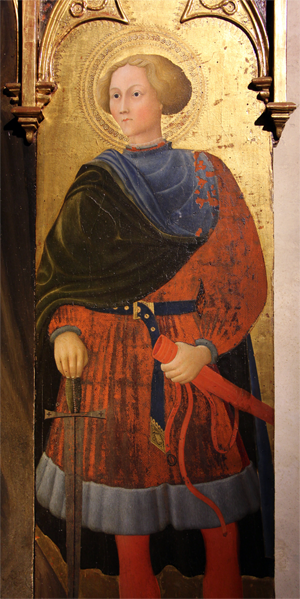
The Horse That Wouldn’t Move
According to the legend, Galgano tried to ride away from all this religious nonsense. But his horse had other ideas. He tried to ride off, but his horse stopped and wouldn’t budge. Thrown to the ground, he had what we’d now call a spiritual crisis.
When he got up, he found himself at the base of Monte Siepi, the exact hill from his visions. It was like the universe was refusing to let him escape his destiny. So he climbed the hill, probably confused, definitely terrified, and definitely changed.
The Moment Everything Changed
At the top of Monte Siepi, surrounded by wilderness, Galgano had his final confrontation with his old life. He was still carrying his sword, the symbol of his identity as a knight. In medieval culture, a knight’s sword wasn’t just a weapon. It was who he was. Giving up the sword meant giving up everything.
There, on that hilltop, Galgano renounced knighthood. He gave away everything he owned. And then, in a gesture that would echo through centuries, he took his sword and stabbed it into the rock.
Not for show. Not as a challenge. As a statement. The sword, driven point-first into stone, formed a cross. What had been an instrument of death became a symbol of faith. What had been a tool of violence became a marker of peace.
The Sword That Shouldn’t Exist
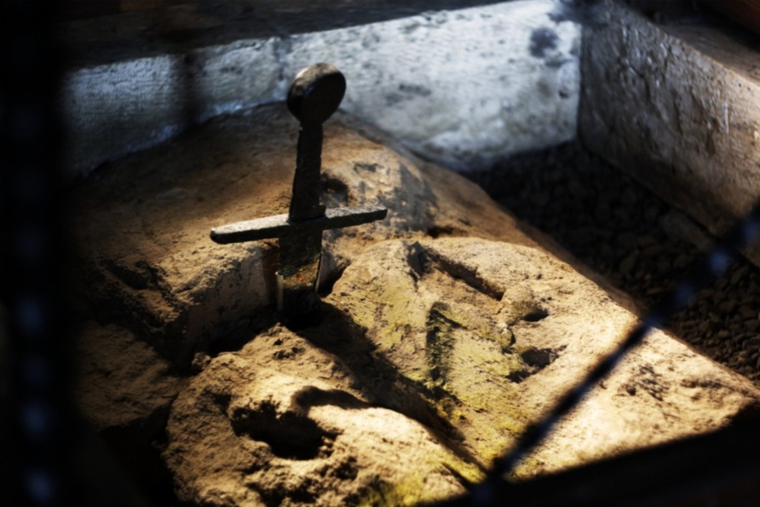
Here’s where it gets weird: the sword is still there. And it’s not some replica. Multiple studies, including metal dating, confirm it’s from the 12th century. It’s been there for 840-plus years, right where Galgano left it.
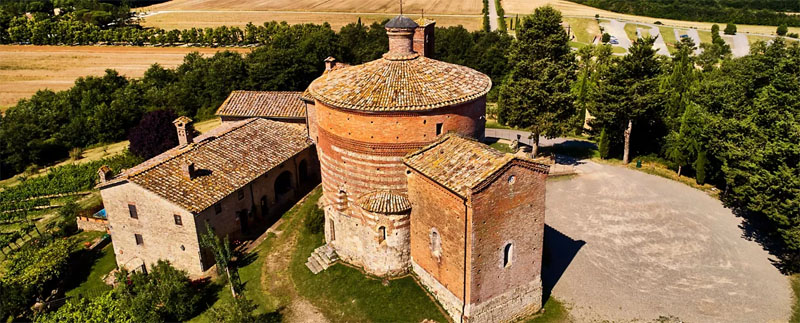
The Rotonda di Montesiepi, a circular chapel, was built around it between 1181 and 1185. The building itself is a remarkable piece of Romanesque architecture, with red and white striped stone and a domed roof. But tourists don’t come for the architecture. They come for the sword.
Some call it the “Italian Excalibur.” Except, unlike King Arthur, Galgano didn’t pull the sword out of the stone. He put it in as a rejection of power, violence, and the knightly code that had defined his life.
The irony is beautiful. Arthur’s sword is about claiming power. Galgano’s is about giving it up.
What Science Says About the Impossible Sword
For centuries, people assumed the sword was either a fake created to mimic Arthurian legends or some kind of natural formation that coincidentally looked like a sword. Skeptics pointed out that you can’t just stab a sword into solid rock. Physics doesn’t work that way.
But in the early 2000s, researchers from the University of Pavia did metallurgical tests on the sword and confirmed it aligns with other 12th-century weapons. Italian chemist Luigi Garlaschelli led the study and concluded that the composition of the metal and the style of the sword are consistent with weapons from Galgano’s era.
The researchers also used ground-penetrating radar to examine the area around the sword. They discovered a cavity beneath it, roughly 2 meters by 1 meter, which may contain Galgano’s remains. The saint supposedly died in 1181, just a year after his conversion, and tradition holds he was buried near his sword.
So How Did It Get There?
This is where science hits a wall. The sword is real and old, but how did a medieval knight drive a metal blade into solid rock? Several theories exist, none entirely satisfying.
One possibility is that the “rock” isn’t as solid as it appears. Some geologists have suggested it might be a type of limestone that was softer when Galgano thrust the sword in, then hardened over time. But this doesn’t entirely explain how the blade penetrated so deeply.
Another theory suggests the sword wasn’t driven into solid stone but into a natural crack or fissure that was then sealed with sediment and minerals over centuries. This is more plausible but less dramatic.
The most mundane explanation? Maybe Galgano didn’t actually stab it into rock. Maybe he placed it in a hole that was already there, and the story grew in the telling. Medieval hagiography, the writing about saints’ lives, often embellished facts to emphasize divine intervention.
But here’s the thing: even if we can’t explain the physics, we can’t deny the power of the symbol. Whether miracle or metaphor, the sword in the stone became exactly what Galgano intended, a permanent rejection of violence.
Saintly Drama: Assassins, Miracles, and Mummified Hands
After Galgano’s death in 1181, things got weird. The Church moved quickly to canonize him. Pope Lucius III declared him a saint in 1185, making him reportedly the first saint whose canonization was conducted through a formal process by the Church.
But medieval sainthood wasn’t just about good vibes and prayers. His tomb became a pilgrimage site almost immediately. People came from across Tuscany and beyond, seeking miracles, healings, and spiritual guidance from the former knight turned holy man.
The Thief’s Terrible Fate
One of the best legends? When monks tried to steal the sword, their arms were miraculously withered. One tale says a thief’s hand was severed by divine force and mummified. Another version claims an assassin, sent by the Devil himself, tried to kill Galgano but was torn apart by wolves who protected the hermit.
That mummified hand, or rather a pair of them, is actually on display in a side chapel at Montesiepi. They’re behind glass, shriveled and brown, allegedly the remains of someone who tried to remove the sword. Carbon-dating tests have confirmed these hands date back to the 12th century, which means they’re as old as Galgano’s story claims.
Whether they actually belonged to a would-be sword thief or were just medieval relics repurposed for a good story, who knows? But they serve their purpose: deterring anyone who might think about messing with the sword.
Creepy? Definitely. Convincing? Depends on your tolerance for medieval weirdness.
The Legends That Multiplied
Other miracles were attributed to Galgano after his death. Supposedly, he performed 19 miracles during his brief time as a hermit. The canonization documents list healings, visions, and other supernatural events witnessed by people who knew him.
One particularly strange claim was that Galgano’s severed head continued to grow blond hair for years after his death. The head was originally kept in a chapel at Montesiepi but was later moved to a church in Chiusdino, his birthplace. Whether the hair-growing miracle actually happened or was medieval marketing, it certainly helped attract pilgrims.
Did Italy Inspire King Arthur?
Here’s where things get really interesting. The legend of King Arthur and Excalibur is usually traced to Celtic and Welsh traditions, compiled by writers like Geoffrey of Monmouth in the 12th century. But the first clear mentions of Arthur pulling a sword from a stone appear in poems by Robert de Boron in the late 12th and early 13th centuries, decades after Galgano’s death and canonization.
Some scholars have suggested that tales of Galgano’s sword in the stone traveled north with pilgrims using the Via Francigena, a major medieval pilgrimage route that connected Rome to Northern Europe and passed near Chiusdino. Pilgrims hearing about the Italian knight who put his sword in stone might have carried that story back to France and England, where it merged with existing Arthurian legends.
Supporting this theory: the Round Table of Arthurian legend and the round chapel of Montesiepi. The name Galgano and the knight Sir Gawain. The role of a holy figure, Merlin in Arthur’s story, the Archangel Michael in Galgano’s, guiding the hero to his destiny.
It’s speculative, of course. Arthur’s legends have roots that predate Galgano. But the specific detail of a sword in stone becoming a test of worthiness? That might be Italian.
The Abbey That Rose and Fell
By 1220, less than 40 years after Galgano’s death, Cistercian monks had built San Galgano Abbey in the valley below Montesiepi. It was a massive Gothic structure, one of the most impressive Cistercian buildings in Italy, designed to accommodate the thousands of pilgrims visiting the saint’s shrine.
The abbey thrived for about a century. Then, like so many medieval institutions, it fell into decline. By the 16th century, it had been largely abandoned. In 1548, a corrupt abbot named Giovanni Andrea Vitelli literally sold the roof. He removed the lead covering and sold it to pay debts, leaving the church open to the elements.
Today, San Galgano Abbey is one of the most hauntingly beautiful ruins in Tuscany. The walls still stand, towering Gothic arches pointing skyward. But there’s no roof. The floor is grass. Sunlight streams through where stained glass once was. It’s become a popular location for weddings, concerts, and photo shoots, a sacred space reclaimed by nature.
The Power of Saying No
What gets me about Galgano’s story isn’t the sword, impressive as it is. It’s the message underneath. Here’s this arrogant guy who, by all accounts, had every reason to chase power, prestige, and probably some medieval-style partying. His family expected it. His social class demanded it. His training as a knight prepared him for a life of violence in service of lords and kings.
And he says no. No to the violence. No to the expectations. No to the war machine of his time. No to the path that seemed inevitable.
He picks peace. And he makes it physical, visible, permanent. A sword, buried in stone, transformed from weapon to cross.
What It Means in a Violent World
In 12th-century Europe, violence was everywhere. Feudal lords fought constant territorial wars. Knights were professional killers, expected to commit atrocities without question. The Crusades were raging, with Christian armies slaughtering Muslims and Jews in the name of God. Peasants suffered under brutal systems of control.
Into this world came Galgano, saying violence itself was wrong. Not just excessive violence, not just violence against the innocent, but the entire system of martial honor that justified killing. He rejected the code that said a knight’s worth was measured in enemies slain.
That rejection wasn’t passive. He didn’t just walk away quietly. He created a symbol that would outlast him by centuries, forcing every pilgrim who saw it to confront the same question he’d faced: is there something more important than power?
That’s not just history. That’s a challenge that echoes across time.
Visiting the Sword Today
Montesiepi Chapel is still there, still open to visitors. You can walk up the same hill Galgano climbed, enter the round stone building, and see the sword for yourself. It’s now protected by a clear plastic case after someone managed to break off part of the blade in the 1960s, but you can still see most of it, protruding from the rock at an angle, the hilt exposed like a cross.
The chapel itself is intimate, almost cave-like. Faded frescoes by Ambrogio Lorenzetti decorate the walls, including one depicting Galgano offering his sword to the Archangel Michael. Sunlight filters through small windows, illuminating the ancient stone.
It’s free to enter, open daily from morning until sunset. On Sunday mornings at 11:30, they still hold Mass there, eight centuries of continuous worship in that small space.
Most tourists combine the visit with a trip to San Galgano Abbey, about a mile down the hill. The juxtaposition is striking: the intact, living chapel above, and the magnificent ruin below, both testaments to the same story told in different ways.
Final Thoughts: Not All Heroes Draw the Sword
We love stories where the hero grabs the weapon and charges into glory. That’s the narrative we’re fed constantly: take up arms, fight the good fight, prove yourself through violence. Even in stories about peace, we usually get there through war.
But Galgano flips that script completely. He becomes a legend by walking away. By refusing to play the game. By transforming his weapon into a monument to what he’s giving up.
The sword in the stone isn’t about kingship here. It’s not about proving worthiness to rule. It’s about surrender. About choosing a different kind of strength. About making peace a physical act rather than just a nice idea.
And somehow, that’s even more radical than pulling a sword out. Any strong person can draw a blade. It takes a different kind of courage to put one down and walk away forever.
The Lesson That Lasts
Galgano Guidotti lived for only 33 years, and only one of those years was spent as a hermit. Yet that single year, and the choice he made on Monte Siepi, has resonated for over eight centuries.
The sword remains because Galgano left it there. The story endures because he refused to live the story everyone expected of him. The miracle, if there is one, isn’t that the blade went into the rock. It’s that the message survived.
So next time someone talks about King Arthur and Excalibur, tell them Italy had its own version of the sword in the stone. But the Italian knight didn’t need to pull the sword out to prove himself.
He just needed to leave it there. And trust that sometimes, the most powerful thing you can do with a weapon is refuse to use it.
Eight hundred years later, that sword is still making its point, literally and figuratively. Still challenging every person who sees it to ask: what would you be willing to give up for peace? What sword would you drive into stone?
Those are questions we still need to answer. And maybe that’s why Galgano’s story, improbable as it sounds, refuses to be forgotten.
Sources:
1. BBC: The Real Sword in the Stone
2. University of Pavia Study on Galgano’s Sword
3. Atlas Obscura on Galgano Guidotti
4. San Galgano Abbey Tourism Site