Imagine Your Toddler Writing Symphonies. No, Seriously.
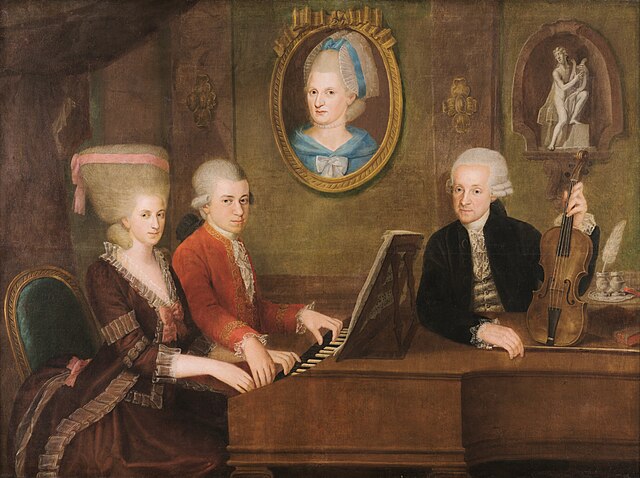
It sounds like a tall tale, doesn’t it? The kind of exaggerated legend your great-uncle spins at dinner after three glasses of Riesling. But here is the reality: Wolfgang Amadeus Mozart wasn’t just “good for his age.” He wasn’t a “gifted student” who played his scales correctly. Before he had even lost all of his baby teeth, Mozart was composing complex musical structures that are still performed by world-class orchestras in the 21st century.
By the age of five, Wolfgang had penned his first compositions. These weren’t “Twinkle Twinkle Little Star” knockoffs or simple three-note melodies. We are talking about legit, structurally sound music. He handled the harpsichord as if it were a physical extension of his own nervous system. Within a few short years, he was traversing the muddy roads of Europe, dazzling emperors and empresses who likely had no idea how to process this powdered-wig-wearing mini-genius who could improvise better than their court composers.
The OG Boy Band Tour: The 1760s Grand Tour
If you think modern “momagers” or stage parents are a new phenomenon, meet Leopold Mozart. Leopold was the original architect of the child-star phenomenon long before the era of Disney Channel or social media. A professional musician and author himself, Leopold recognized early on that his son wasn’t just special—he was a once-in-a-century anomaly.
In 1763, Leopold packed up Wolfgang and his equally talented sister, Nannerl, and hit the road for what would become a grueling three-year “Grand Tour.” Imagine the logistics: no Wi-Fi, no climate-controlled tour buses, and no modern medicine. We are talking about bone-shaking travel in horse-drawn carriages over unpaved roads, enduring freezing winters and sweltering summers. They moved from Munich to Paris, London to The Hague, performing in cold, candlelit drawing rooms for the elite of the Enlightenment.
During these tours, Wolfgang wasn’t just playing prepared pieces. He was a human jukebox of high-level musical feats. Audiences would challenge him to improvise a fugue on a theme they had just whistled, or ask him to play the keyboard with a cloth covering the keys so he couldn’t see his fingers. He passed every test with a smirk. Despite the exhaustion that would break an adult, the kid thrived on the attention.

How Does That Even Happen? The Mystery of the Mozart Brain
Scientists and psychologists today still treat Mozart’s brain as a sort of “holy grail” of cognitive study. How does a child internalize the complex mathematics of counterpoint before they can even do long division?
Yes, Mozart was a prodigy, but it wasn’t just magic. His brain was the result of a perfect storm: innate biological talent, immersion in a musical household from birth, and a level of obsession that bordered on the fanatical. His auditory processing was legendary. There is a famous story of a teenaged Mozart visiting the Sistine Chapel and hearing Allegri’s Miserere—a closely guarded piece of music that the Pope forbade anyone from transcribing. Mozart heard it once, went back to his room, and wrote it down note-for-note from memory. That isn’t just a “good ear”; that is bordering on the supernatural.
However, we shouldn’t paint him as a robotic overachiever. Leopold was a “Tiger Dad” with a violin bow, pushing Wolfgang and Nannerl relentlessly. But Wolfgang’s own personality was the ultimate counterweight to this discipline. His letters reveal a man who was cheeky, restless, and often downright goofy. He had a famous—or perhaps infamous—love for bathroom humor and crude wordplay. He was a man of deep emotional sensitivity who could write a heartbreakingly beautiful mass one hour and a series of scatological jokes the next. He was weird in the way only a true genius can be.
From Child Star to Freelance Icon (With Real-World Bills)
As Wolfgang grew up, the “prodigy” novelty wore off. Stardom rarely translates into long-term financial stability, a lesson Mozart learned the hard way in Vienna. He eventually butted heads with his employer, the Archbishop of Salzburg, who treated him like a glorified servant. Mozart, who had spent his childhood being kissed by Empresses, didn’t “do” servant life. He wanted independence in a century where musicians were expected to be obedient court fixtures.
So, he did something radical for the 1780s: he went freelance. He moved to Vienna, took on private pupils, organized his own concerts, and chased commissions. This was the era of his greatest hits. He wrote operas like The Marriage of Figaro and Don Giovanni. These weren’t just catchy tunes; they were bold, subversive social commentaries. In Figaro, he essentially used the stage to roast the aristocracy, showing servants who were smarter and more virtuous than their masters. He was speaking truth to power through the harpsichord.
The Financial Rollercoaster of a Genius
Despite his fame, Mozart struggled. He was the 18th-century equivalent of a “gig worker,” albeit a very high-end one. He lived large when the money was flowing—buying expensive clothes, fine billiards tables, and luxury apartments—and then plummeted into desperate debt when the Viennese public moved on to the next trend.
He was notoriously bad with cash and generous to a fault, often lending money he didn’t have to friends who were even worse off. His final years were a chaotic blur of intense creativity and mounting pressure. He was writing some of the most complex music in human history, like The Magic Flute and his final Requiem, while simultaneously dodging creditors and suffering from a mysterious, declining health.
A Legacy That Redefined the Human Soul
Though Mozart’s life was cut short, his legacy didn’t just survive; it evolved. He took the “Classical” style—which was often criticized for being too stiff or formal—and injected it with a raw, pulsing humanity. His ability to blend technical perfection with profound emotional depth is why a symphony written in 1788 can still make a listener in 2025 feel a sense of cosmic yearning or unbridled joy.
Today, his influence is inescapable. You hear his DNA in the sweeping film scores of John Williams and the structural complexities of modern progressive rock. He set the benchmark for what “excellence” looks like. Whether it is a solo piano sonata or a grand choral work, Mozart’s music has a quality often described as “transparent”—it sounds simple and effortless, yet it is incredibly difficult to perform perfectly. There is nowhere to hide in a Mozart score.
The Final Movement: A Common Grave for an Uncommon Man
Mozart died at the age of 35. That number always stings. He didn’t get a dramatic finale or a state funeral. Because of the burial customs in Vienna at the time (and his own precarious finances), he was buried in a “common” grave—not a pauper’s pit, as legends often claim, but an unmarked spot intended for the middle class. There was no grand monument at first.
But his music didn’t need a tombstone. It took flight. Within decades of his death, he was recognized as a titan. Today, he is everywhere: in concert halls, elevator music, cartoons, and scientific studies about spatial intelligence (the “Mozart Effect”). He remains the gold standard of human potential.
Knowing that he accomplished all of this—over 600 works—before most of us even figure out how to file our taxes or choose a career path is both humbling and mind-blowing. It reminds us that genius doesn’t always come in a neat, professional package. Sometimes it comes in the form of a man who couldn’t balance a checkbook, loved bad jokes, and wrote music that sounds like the voice of the universe.
What Do We Take Away?
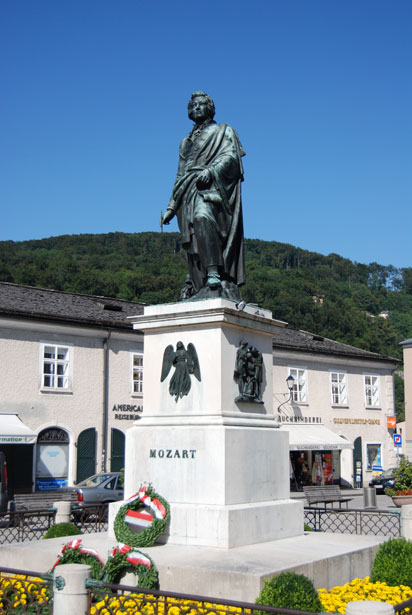
We remember Wolfgang not as a marble statue, but as a human lightning strike. He teaches us that brilliance is often messy, that talent requires grueling work to manifest, and that even a short life can leave an echo that lasts for centuries. Mozart wasn’t just a prodigy; he was a reminder of what the human mind is capable of when it refuses to play by the rules.
Sources:
1. Solomon, Maynard. Mozart: A Life. HarperCollins
2. Zaslaw, Neal. Mozart’s Symphonies: Context, Performance Practice, Reception. Oxford University Press
3. The Mozart Project. https://www.mozartproject.org/
4. Letters of Mozart. Translated by Emily Anderson.