Imagine standing in the middle of a frozen steppe, winds gnawing at your face, nothing but ice and silence stretching to the horizon. You look down, and there they are. Footprints. Two sets. One human. One canine. Perfectly preserved side by side in ancient mud, like some Paleolithic timestamp pressed into the earth 26,000 years ago.
This is not the beginning of a fairy tale. It’s real. It happened. And it just might be the oldest evidence we have of a walk, a literal walk, between a person and their dog.
A Trail of Clues Frozen in Time
In the French region of Chauvet and the Czech Republic’s Pavlov Hills, archaeologists have been finding traces of ancient humans and animals for decades. But one of the most haunting finds was uncovered in the depths of Chauvet Cave. Inside, along a corridor untouched by sunlight for tens of millennia, scientists discovered the footprints of a child and a large dog-like creature walking side by side.
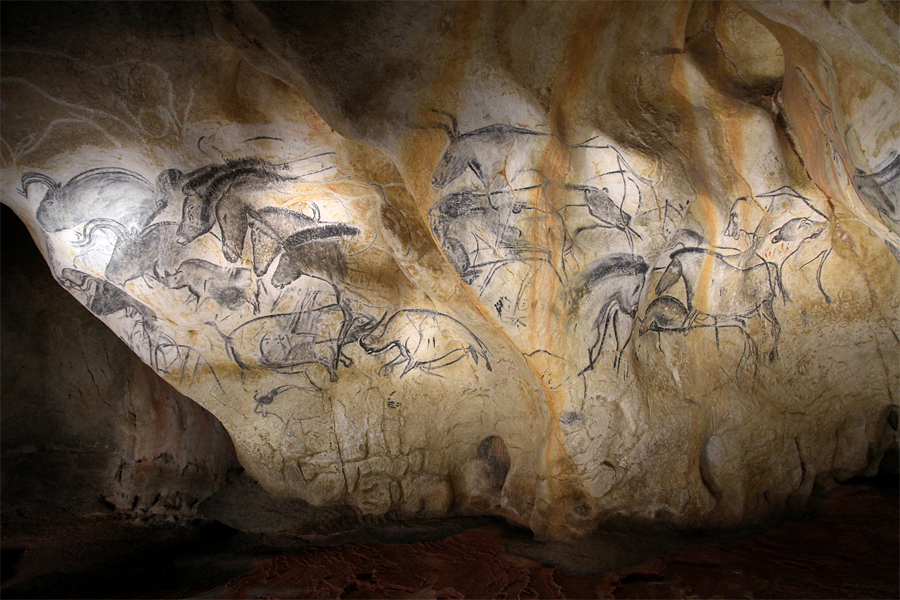
The cave itself is already legendary. Discovered in 1994, it contains some of the oldest and most sophisticated cave paintings ever found, dating back more than 30,000 years. Lions, mammoths, rhinoceroses, all rendered in stunning detail by Ice Age artists who understood perspective and movement in ways that wouldn’t be seen again for thousands of years.
But tucked away from the painted galleries, in a quieter section of the cave, were these footprints. The tracks weren’t scattered. They weren’t confused. They were deliberate. Measured. Like someone, some kid, just went out for a walk with their four-legged buddy. And this walk, preserved thanks to a combination of damp clay and a rare lack of disturbance, gives us a snapshot of a relationship that predates history itself.
The preservation is almost miraculous. After the child and dog passed through, the cave’s conditions stabilized perfectly. No flooding. No collapse. No animals trampling through. The clay hardened slowly, capturing every detail. You can see the arch of the child’s foot, the pressure points where the dog’s paws pressed deeper on certain steps. It’s forensic evidence of a moment that lasted maybe ten minutes but has echoed for 26,000 years.
Were They Dogs? Or Wolves in Transition?
Okay, let’s get the skeptics out of the way. Some folks argue that what we call “dogs” weren’t technically around 26,000 years ago. They might’ve been proto-dogs. Domesticated wolves. Fuzzy gray areas in taxonomy. But the tracks weren’t wolf tracks, not exactly. Their shape and depth suggest a creature already adapting to life with humans. Shorter snouts. Smaller sizes. Not just scavengers anymore, but companions.
The scientific debate around dog domestication is messy. Genetic studies point to dogs splitting from wolves somewhere between 15,000 and 40,000 years ago. The timeline keeps shifting as new evidence emerges. What we do know is that dogs were the first domesticated animals, predating agriculture, settled civilization, even pottery.
Either way, semantics don’t dull the impact. It’s the intent that moves us. Something about that side-by-side movement screams familiarity. Partnership. Trust. Wild wolves don’t casually stroll through dark caves with human children. Whatever this creature was, it had crossed a threshold. It had chosen proximity over survival instinct.
Why Were They Walking There?
This is where the imagination kicks in. What was a kid doing deep inside a cave with a dog-like animal?
Some archaeologists think they were exploring, maybe even helping decorate the walls with those stunning cave paintings. There’s evidence of charcoal smudges and firelight shadows that suggest human activity far from the entrance. The cave wasn’t just visited, it was used, inhabited, transformed into something sacred.
Children in Paleolithic societies weren’t kept separate from adult activities the way modern kids often are. They participated. They learned by doing. A child helping to create art or participating in rituals deep in a cave wouldn’t be unusual. And bringing along a companion animal? That tracks too.
Or maybe they were hiding. Maybe this was their secret place, a place of ritual or refuge. The cave was active during the Ice Age, remember. Outside was unforgiving. Temperatures plunged well below freezing. Massive predators like cave bears, lions, and hyenas roamed the landscape. Inside? A canvas, a shelter, maybe even a little warmth from the thermal mass of the earth.
Some researchers have suggested the child might have been around eight to ten years old based on foot size. Old enough to venture into the cave’s depths. Young enough to feel invincible, the way kids do. And the dog, or proto-dog, was large. Shoulder height estimated around two feet. Big enough to offer protection. Companionship. Courage in the dark.
Whatever the reason, the emotional core remains: they were together. That kid wasn’t alone.
The First Walkies
It’s strange how little things survive. You could burn down cities, and centuries later, people might dig up a few coins or bricks. But here we are, reading a literal path in the mud like an ancient diary entry. It says: someone was here. And they brought their dog.
We like to think of things like pet ownership or animal companionship as modern inventions, something that evolved alongside our convenience and comfort. But these prints tell a different story. One of shared journeys. Maybe even affection. Maybe loyalty before the leash.
You can picture it, can’t you? The kid glancing back every so often, checking if the creature was keeping up. Or maybe the dog bounded ahead, stopping to wait at each twist of the cave, tail wagging in the torchlight. We don’t know. But that’s what makes it beautiful. The mystery leaves room for the universal feeling, the recognition that this is something we still do.
Other evidence supports this ancient bond. In Siberia, scientists found a 33,000-year-old wolf skull with distinctive dog-like features, suggesting domestication was already underway. In Germany, a 14,000-year-old grave contained a human buried with a puppy, carefully positioned like they were sleeping together.
These weren’t food animals. These weren’t tools. These were family.
The Echo That Still Walks With Us
Fast forward to now. We walk our dogs every day without thinking about it. We snap leash clips, pull on sneakers, head to the same old park. Routine, right?
Except it’s not. It’s ancient. It’s encoded in who we are. That tug on the leash? That shared silence on a wooded path? That’s not just a modern pet-human interaction. It’s a re-enactment of something sacred. Something 26,000 years old.
Think about the statistics. There are roughly 900 million dogs on Earth today. In the United States alone, nearly 70 million households have at least one dog. We spend billions on dog food, toys, healthcare, grooming. We restructure our lives around them. We plan vacations they can join. We worry about them when we’re away.
And for what? They don’t pay rent. They don’t contribute economically in any traditional sense. But they offer something else. Something those Paleolithic humans recognized long before cities or farms or written language. Companionship. Loyalty. The comfort of not being alone.
What It Means for Us
This isn’t just about footprints. It’s about continuity. It’s about that moment in a cave, when a human and a dog decided, for whatever reason, to go somewhere together. And it left a mark that outlasted empires, languages, even the invention of writing.
The relationship between humans and dogs might be the longest continuous partnership in our species’ history. Longer than marriage as an institution. Longer than any government. Longer than organized religion. We’ve been walking together since before we learned to plant seeds or build permanent shelters.
And that, in a weirdly comforting way, makes you feel kind of small and kind of eternal all at once.
Next time you’re out with your dog, whether it’s a morning routine around the block or a hike through the woods, stop for a second. Look down at your feet and theirs, moving in rhythm. You’re part of something older than civilization. You’re walking the same path that child walked 26,000 years ago, following the same instinct to share the journey with a creature who chose us as much as we chose them.
The footprints in Chauvet Cave are silent, but they speak volumes. They say that love, or something like it, existed before we had words for it. That companionship was worth bringing into the dark. That some bonds are so fundamental to being human that they literally became part of our evolutionary story.
Those prints are still there, waiting in the darkness, proof that the best things about humanity have always been the simplest: walking together, not alone.
Sources:
1. National Geographic: Ancient Footprints May Be Earliest Evidence of Human-Dog Bond
2. Science Magazine: Dogs Domesticated Twice?
3. BBC: Chauvet Cave and the Origins of Art