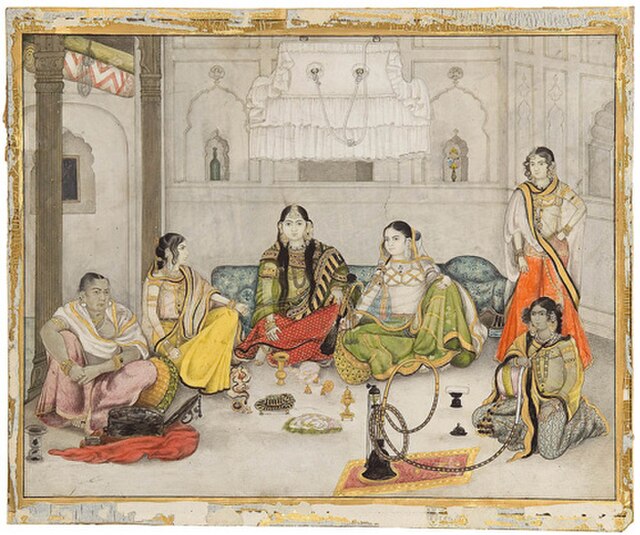
If you were a king in ancient India, there was one kind of woman you absolutely didn’t want to see in your court: the kind who looked stunning, smiled sweetly, and could kill you with a kiss.
Welcome to the Deadliest Weapon Nobody Saw Coming
Forget daggers hidden in cloaks or cups of wine laced with arsenic. In ancient and medieval India, some kingdoms trained young girls to be living weapons. These weren’t assassins in the traditional sense. They didn’t carry blades or poisons in vials. They were the poison.
Known as Vish Kanyas, literally, “poison maidens,” they were raised on tiny doses of venom from early childhood. Scorpions. Snakes. Toxic herbs. Hemlock. Oleander. You name it, they ingested it in carefully calibrated amounts. The goal? To build immunity through a process called mithridatism (named after King Mithridates VI of Pontus, who supposedly did the same thing). And, more horrifyingly, to turn their very bodies into vectors of death.
Kiss them, touch them, share a meal, sometimes even just being close to them for extended periods, and you’d fall ill. Maybe even die. Beauty, after all, is most dangerous when it doesn’t have to draw a blade.
The concept is as brilliant as it is terrifying. What better way to eliminate a rival than to send him exactly what he wants? A beautiful woman, trained in all the courtly arts, irresistible and deadly. She doesn’t need to sneak poison into his cup. She is the poison.
Are We Talking History or Legend?
Great question. The Vish Kanya story walks the razor’s edge between documented history and dark folklore. Ancient texts like the Arthashastra, attributed to the brilliant strategist Chanakya (also called Kautilya), advisor to Emperor Chandragupta Maurya around 300 BCE, mention the use of these women for political assassinations.
The Arthashastra is essentially an ancient Indian treatise on statecraft, economic policy, and military strategy. Think of it as “The Prince” by Machiavelli, but written 1,800 years earlier and far more comprehensive. It covers everything from tax collection to espionage to the proper way to conduct warfare. And yes, it includes a section on using poison maidens as weapons.
Chanakya himself, according to legend, used a poison maiden to eliminate a rival king who threatened Chandragupta’s expanding Mauryan Empire. She was sent as a diplomatic gift, a gesture of goodwill. Yes, an actual gift. Wrapped in beauty. Sealed with death. The rival king, enchanted by her, took her as a consort. Within weeks, he was dead. No siege necessary. No army lost. Just one strategically deployed woman.
Now, were they real? Or symbolic of deeper fears around women’s agency, sexuality, and power? Possibly both. Historical records are murky. The Arthashastra was written as a guide, a manual for rulers, which means some of its content might be theoretical rather than describing common practice. But the myth had legs. It echoed for centuries, appearing in various forms across South Asian and Southeast Asian literature, which tells you something.
The story also appears in the Kathasaritsagara, an 11th-century collection of Indian legends and folk tales, and in various regional texts across the subcontinent. The consistency across sources suggests either a persistent legend or an actual practice that captured the cultural imagination.
How Do You Even Become a Poison Maiden?
Here’s the chilling part. These girls weren’t volunteers. Many were likely orphans, captured enemy children, or taken in by rulers or elite houses with the specific intent to raise them as human weapons. Starting at a young age, sometimes as early as infancy according to some texts, they were given microdoses of poisons in food and drink.
The process would be gradual, methodical, overseen by physicians and poisoners who understood dosages. Start with amounts so small they wouldn’t cause serious harm, then slowly increase over months and years. Some girls died during training. Their bodies couldn’t adapt. Others became, well, immune. And lethal.
The science here is actually partially sound. Mithridatism, the practice of ingesting small amounts of poison to build immunity, does work for some toxins. Your body can develop tolerance to certain venoms and plant-based poisons. Arsenic, for instance, can be tolerated in increasing doses. Snake venom, if ingested (rather than injected), is often broken down by stomach acids, though this varies by venom type.
But could a person actually become poisonous to others through touch or kiss? That’s where science gets skeptical. Most toxins would need to be transferred in significant quantities through bodily fluids, and even then, the concentration would likely be too low to kill. Unless the poison maiden was continuously dosing herself with substances that could be transmitted through saliva, sweat, or other secretions, the lethality is questionable.
However, the psychological power of the myth didn’t require scientific accuracy. The fear was enough.
Beyond poison immunity, these girls would be trained in seduction, etiquette, music, dance, and courtly arts. They had to be irresistible, cultured, and refined. Think James Bond femme fatale but with more Sanskrit poetry and far less agency. They needed to blend seamlessly into court life, to become trusted, desired, and ultimately, deadly.
Some legends even say their sweat or breath was toxic, that their very presence in a room could sicken those around them over time. Honestly? We don’t know how much of that is science versus fear-stoked storytelling designed to create maximum paranoia. But the fact remains: these girls, if they existed as described, were tools of statecraft. Romanticized by some, feared by many, remembered by few.
Why Would Anyone Use a Human as a Weapon?
The answer is simple and brutal: power.
In ancient India, kingdoms were constantly competing for territory, resources, and dominance. Warfare meant massive risk and bloodshed. Armies were expensive. Battles were unpredictable. Even victorious campaigns resulted in significant losses. But stealth assassinations? Those looked like genius. Efficient. Clean. Strategic.
Send a woman instead of an army. Let the enemy open the door willingly. Let him fall in love, let him trust her, let him bring her into his most private chambers where guards don’t follow. Then let him die in agony, with no witnesses, no proof, no clear culprit.
It wasn’t just about killing. It was psychological warfare on a massive scale. Imagine the paranoia that followed a successful poison maiden assassination. Every dancer, every consort, every unfamiliar servant, every diplomatic gift, became a potential executioner in silk. Trust evaporated. Alliances became fraught with suspicion. Kings would isolate themselves, refuse gifts, reject beautiful women out of fear.
This fear was, in many ways, more valuable than the actual assassinations. A paranoid king makes mistakes. He alienates allies. He sees enemies everywhere. His court becomes dysfunctional. His judgment becomes clouded. All without a single drop of poison being used.
The Arthashastra is remarkably cold-blooded about this. It treats poison maidens as just one tool among many in the arsenal of statecraft. Alongside spies, double agents, propaganda, economic sanctions, and conventional warfare. Chanakya viewed politics as amoral, a game played for survival and dominance where sentiment had no place.
Women as Weapons: A Broader Context
The Vish Kanya story doesn’t exist in isolation. Throughout history, across cultures, women have been deployed as political tools, though rarely as dramatically. Royal marriages were strategic alliances. Concubines and courtesans gathered intelligence. Beautiful women were sent as gifts to distract, seduce, or manipulate rival leaders.
What makes the poison maiden unique is the explicit violence, the way these girls were literally transformed into weapons from childhood. They had no choice in their fate, no agency in their deployment. They were raised to be expendable, their lives measured only by their utility to power.
This raises uncomfortable questions about how societies have viewed women, particularly beautiful women. The Vish Kanya myth contains deep anxieties about feminine power, about the danger of female sexuality, about the fear that beauty might hide deadly intent. These are themes that echo across cultures in figures like Lilith, the sirens, Cleopatra, Mata Hari.
But it’s also specifically about the instrumentalization of human beings, the reduction of people to tools. The poison maiden couldn’t refuse her role. She couldn’t choose a different life. She was property, weapon, sacrifice.
Echoes in Pop Culture and Modern India
The Vish Kanya shows up now and then in films, TV shows, and novels, particularly in Indian media. Usually portrayed as a tragic beauty or seductive villain, she’s become a stock character, a trope. There have been Bollywood films, television series, and comic books featuring poison maidens.
But those are just shadows of the real story. The ethical horror of turning a child into a weapon tends to get glossed over in favor of intrigue and romance. Modern portrayals often give the Vish Kanya agency she historically wouldn’t have had, making her a willing participant or even a hero using her abilities for good.
In some ways, this modern reimagining is understandable. We want to find power and choice in stories about women, especially in stories where they were originally depicted as passive tools. But it also risks sanitizing something genuinely horrific, making palatable a practice that was, at its core, about control and exploitation.
Still, the myth persists in cultural consciousness. Why? Maybe because it touches a nerve we haven’t quite severed. The idea that power can wear a lovely face. That femininity can be deadly. That innocence can be engineered into destruction. That the most dangerous threats don’t announce themselves.
There’s also something deeply compelling about the tragedy of it. A girl raised from birth for a single purpose, her childhood stolen, her body transformed into something unnatural, her life ultimately expendable. That’s horror of a very human kind.
The Science (and Pseudoscience) of Poison Immunity
Let’s talk about whether this could actually work. Mithridatism is real, to a point. King Mithridates VI of Pontus allegedly took small doses of poisons throughout his life to protect himself from assassination. When he was finally defeated and wanted to commit suicide by poison, according to legend, he couldn’t because he’d built up too much immunity.
Your body can develop tolerance to certain toxins. Arsenic is the classic example. People in certain regions where arsenic occurs naturally in water have developed some tolerance. Snake handlers who’ve been repeatedly exposed to small amounts of venom through minor bites can develop partial immunity.
But there are serious limits. Many poisons will simply kill you in slightly higher doses. The margin between “building immunity” and “dying horribly” is often razor-thin. And crucially, becoming immune doesn’t make you poisonous to others in most cases.
For a Vish Kanya to actually kill through bodily contact, she’d need to be ingesting or absorbing substances that would:
Not kill her despite high concentrations
Be present in her saliva, sweat, or other secretions in lethal amounts
Remain toxic when transferred to another person
This is… unlikely. Most toxins that could achieve this would be too dangerous to the carrier herself. You’d need something that’s harmless when absorbed slowly but deadly when transferred suddenly in concentrated form. Such substances exist but are rare.
More likely, if poison maidens existed, they carried poison externally, perhaps on their lips, their clothing, or their jewelry, and the immunity training was partly theater, partly insurance in case they were exposed to their own weapons.
Or, the whole thing was psychological warfare. The threat was enough. Actual scientific viability didn’t matter if your enemies believed it.
So, What Do We Make of It Now?
Let’s be real. The Poison Maiden isn’t just a tale of ancient India. It’s a mirror reflecting something universal and disturbing. It reflects how societies use people, especially women and children, as tools. How beauty becomes currency. How fear wraps itself in silk and teaches little girls to carry death in their veins.
It’s about the cold calculations of power, the willingness to sacrifice individuals for strategic gain, the dehumanization that occurs when people become means rather than ends. Every political system has done this in various ways. The Vish Kanya is just one particularly vivid example.
And yet, there’s something undeniably compelling about the story. Maybe because it’s so extreme. So human in its cruelty and its creativity. So emblematic of the lengths people will go to gain advantage over rivals.
It also speaks to enduring fears about intimacy and trust. The poison maiden represents the ultimate betrayal: the person you let closest, the one you desire most, becomes the instrument of your destruction. That’s a fear that transcends time and culture. Who can you trust? What if love is a trap? What if beauty is a weapon?
These questions still resonate. We see them in modern spy thrillers, in political dramas, in discussions about surveillance and betrayal. The details change but the anxieties remain.
The Forgotten Victims
Somewhere between myth and history, between strategy and tragedy, the Vish Kanya walks. Silent. Beautiful. Forgotten by most. But never entirely gone.
If these girls existed, they deserve to be remembered not as exotic curiosities or romantic villains, but as victims. Children stolen from normal lives and transformed into weapons. Girls who never chose their fate, who were poisoned slowly over years, who were denied agency, love, and future. Who were deployed like arrows and discarded like spent ammunition.
Their story, real or legendary, is a reminder that the great games of empire and power are played on the backs of the powerless. That every strategic triumph has human cost. That history’s footnotes are often its greatest tragedies.
Next time you encounter the Vish Kanya in a movie or novel, remember there’s a darker truth beneath the entertainment. Remember the girls who might have lived this nightmare. Remember that some weapons bleed.
And maybe, just maybe, ask yourself what modern equivalents exist. How do we still turn people into instruments? How do we still sacrifice individuals for larger goals? What poison are we feeding our children, literally or metaphorically, in service of power?
The Vish Kanya might be ancient history. But the impulse that created her is very much alive.
Source:
1. Kautilya’s Arthashastra (translated by R. Shamasastry)
2. “Vishkanya: Myth or Reality?” by Devdutt Pattanaik
3. Times of India archive on Vish Kanyas in folklore
4. BBC History: India and the art of political intrigue