When Married Women Were Banned from the Olympics (and What They Did About It)
Imagine this:
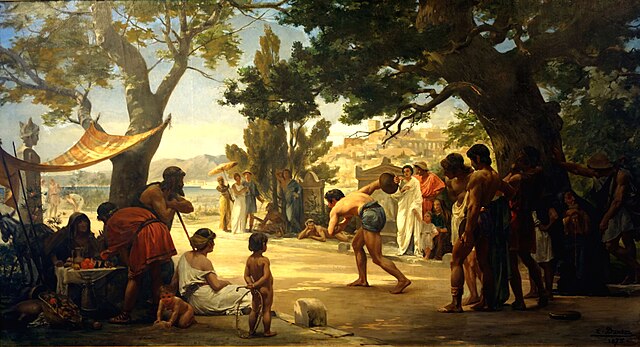
You’re a married woman in ancient Greece. The Olympics are in full swing, athletes sprinting, wrestling, and hurling javelins under the scorching sun. The air buzzes with excitement. Thousands of spectators are shouting, placing bets, watching history unfold. But you? You’re not allowed to watch. Not even from the sidelines. In fact, if you’re caught sneaking a peek, the penalty could be as severe as being thrown off a cliff.
Yes, really.
The Ancient Olympics: A Men’s Club
The original Olympic Games, held in Olympia starting in 776 BCE, were as much religious festivals as athletic competitions. Dedicated to Zeus, they were steeped in rituals and traditions that made them fundamentally different from the modern Olympics we know today. One such tradition? Excluding women, specifically married women, from attending. Unmarried women, or parthenoi, were sometimes allowed to watch, but married women faced strict prohibitions.
The reasoning? Athletes competed in the nude, completely naked, and the presence of married women was deemed inappropriate. The sanctity of the games and the religious context made their exclusion a matter of both modesty and piety. But there was more to it than just naked bodies. This was about power, visibility, and who got to occupy public space in ancient Greek society.
The punishment for violating this ban was brutal. According to ancient sources, any married woman caught at the games would be hurled from Mount Typaion, a nearby cliff. Whether this penalty was ever actually carried out is unclear. No historical records document an execution for this offense. But the threat alone was enough to keep most women away.
Think about what that means. You could be a mother watching your son compete for the greatest honor an athlete could achieve, and you weren’t allowed to be there. You could be the wife of a champion, someone who trained alongside him, supported his preparation, and you had to stay home while the entire Greek world celebrated his victory.
Defying the Ban: The Story of Callipateira
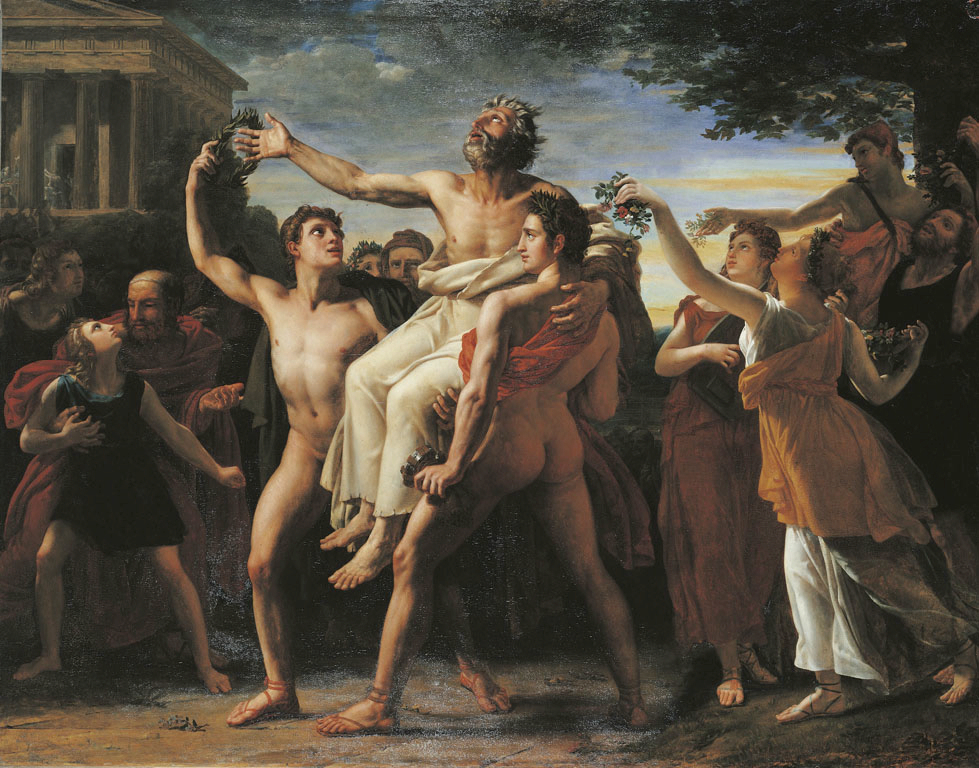
Despite the strict rules, not everyone complied. Pausanias, a Greek traveler and geographer, recounts the tale of Callipateira (sometimes called Pherenike), a widow who disguised herself as a male trainer to watch her son compete. This wasn’t a spur-of-the-moment decision. She had to plan it carefully. Bind her chest, dress in men’s clothing, learn to move and speak like a male trainer.
Her family had serious athletic credentials. Her father was an Olympic champion. Her brothers were Olympic champions. And now her son was competing. She wasn’t going to miss it.
When her son won, Callipateira couldn’t contain herself. She leaped over the barrier separating trainers from spectators in excitement, revealing her identity. The crowd froze. By all rights, she should have been executed on the spot.
Instead of facing punishment, she was honored for her family’s athletic legacy. The judges decided that a woman from such an illustrious Olympic family deserved mercy. However, to prevent future incidents, trainers were thereafter required to attend the games naked, just like the athletes. If you were going to stand on the sidelines coaching, you had to prove you were male. Problem solved, in the most ancient Greek way possible.
Creating Their Own Space: The Heraean Games
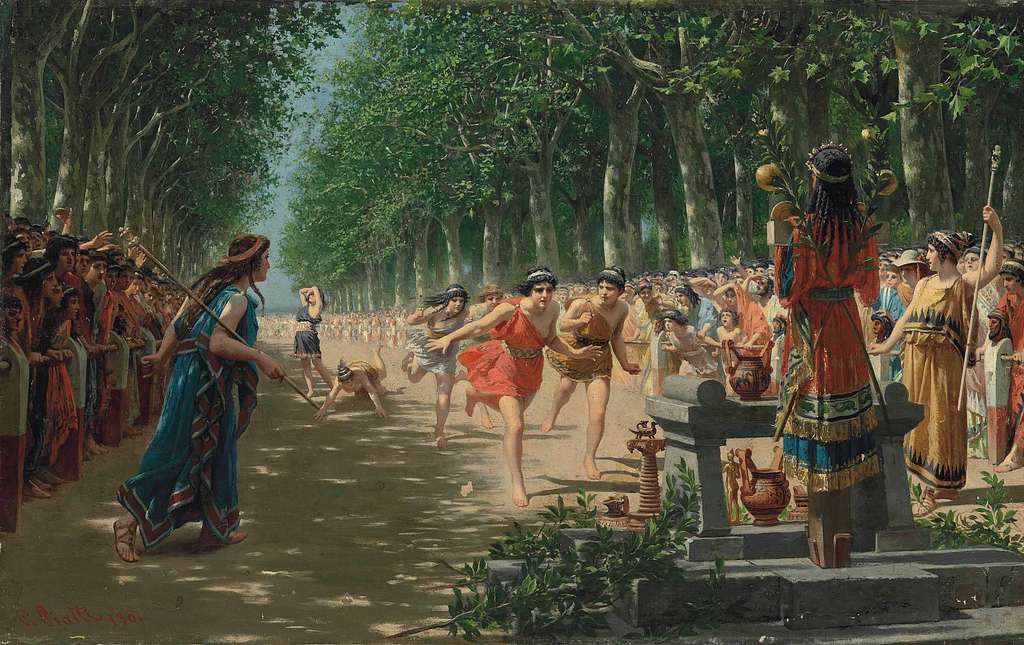
Excluded from the Olympics, women organized their own athletic event: the Heraean Games. Held every four years in Olympia, these games were dedicated to Hera, the goddess of women and marriage. Young, unmarried women competed in footraces, wearing short tunics that ended above the knee and with their hair loose, a stark contrast to typical female attire of the time. Winners received olive crowns and could dedicate statues to Hera, just like male Olympic champions.
The races were shorter than the men’s Olympic sprint, about five-sixths of the stadium length, roughly 160 meters instead of the full 192-meter stadion race. Whether this was because organizers thought women couldn’t handle the full distance or because it was a separate tradition is debated by historians.
The Heraean Games provided a rare opportunity for women to engage in public athletic competition and gain recognition in a society that largely confined them to domestic roles. These weren’t small, private affairs either. They drew crowds. They had prestige. Winning at Hera’s games meant something.
What’s fascinating is that these games probably predated the Olympics. Some scholars believe the Heraean Games were older, rooted in even more ancient fertility rites and goddess worship. If that’s true, then men didn’t just exclude women from their games. They took over athletic competition entirely and pushed women’s athletics to the margins.
The Real Reason for the Ban
Beyond athleticism, the ancient Olympics were a political and religious stage. They reinforced who held power, physically, socially, and spiritually. Banning married women wasn’t just about modesty or religious purity. It was about control. It defined who could participate, who could watch, and who was considered worthy of visibility and influence in public life.
Ancient Greek society was intensely patriarchal. Women, particularly married women, were expected to remain in the home. The Greek house was divided into men’s quarters and women’s quarters. Respectable women didn’t wander the streets freely. They didn’t attend political assemblies. They didn’t speak in public forums.
The Olympics were the ultimate public forum. Athletes came from every Greek city-state. Politicians made deals. Poets recited new works. Philosophers debated. It was where Greek culture happened, where reputations were made and power was consolidated. Allowing married women into that space would have challenged the entire social order.
Unmarried women got a pass, probably because they weren’t yet considered full participants in the domestic sphere. They were in a liminal state, between childhood and wifely duties. But once you married, you belonged to the private world of the household. Public spectacle was off limits.
Women in the Shadows: Owners and Sponsors
While women couldn’t compete in the Olympics or even watch, they found loopholes. Wealthy women could own and sponsor chariot teams. This was significant because in chariot racing, the owner of the winning team received the victory, not the charioteer who actually raced.
Cynisca of Sparta became the first woman to win an Olympic event by owning a victorious chariot team in 396 BCE and again in 392 BCE. Her success challenged gender norms and demonstrated that women could achieve Olympic glory, albeit indirectly.
Cynisca wasn’t just any woman. She was a Spartan princess, sister to King Agesilaus II. Sparta treated women differently than other Greek city-states. Spartan women exercised, owned property, and had more freedom than their Athenian counterparts. Cynisca trained horses and built a racing program that dominated the Olympics.
She was so proud of her victories that she commissioned a statue and inscription at Olympia declaring herself the only woman to win the chariot race. The inscription still survives in fragments. It reads like a challenge, a middle finger to everyone who said women couldn’t be Olympic champions.
Other wealthy women followed her example. Belistiche, possibly a courtesan, won Olympic chariot victories in the 3rd century BCE. Theodota, another woman, won the two-colt chariot race. They couldn’t set foot in the stadium, but their names were announced as victors, and their achievements were recorded in Olympic history.
The Long Road to Inclusion
When the Olympics were revived in 1896, women were again excluded from competition. Baron Pierre de Coubertin, founder of the modern Olympics, believed women’s sports were “impractical, uninteresting, unaesthetic and incorrect.” He thought women’s Olympic role should be crowning the victors, not competing themselves.
Women fought back. In 1900, women competed in tennis and golf. By 1928, track and field events for women were added, though not without controversy. After the 800-meter race, several women collapsed from exhaustion (just like male athletes often did), and critics used this as evidence that women were too fragile for athletics. The women’s 800-meter race was banned until 1960.
The progress was agonizingly slow. Women’s marathon wasn’t added until 1984. Women’s ski jumping wasn’t included until 2014. It took until the 2012 London Olympics for women to compete in every sport, when women’s boxing was finally added.
Today, women compete in nearly every Olympic sport, and the number of female athletes approaches parity with men. The 2020 Tokyo Olympics (held in 2021) had nearly 49% female participation, the closest to equal representation in Olympic history.
A Reflection on Progress
The exclusion of married women from the ancient Olympics highlights the gender dynamics of the time. Yet, the stories of women like Callipateira and Cynisca show resilience and a desire to break barriers. They didn’t accept exclusion quietly. They found ways around the rules, challenged the system, and forced their way into history.
Understanding this history reminds us of the importance of inclusion and the ongoing journey toward equality in all arenas. It also reminds us that progress isn’t inevitable. It requires people willing to disguise themselves and jump barriers. People willing to spend their fortunes proving a point. People willing to organize their own games when they’re shut out of existing ones.
The next time you watch a female athlete stand on an Olympic podium, remember she’s standing there because countless women before her refused to stay home. Because Callipateira risked death to watch her son compete. Because Cynisca spent a fortune proving women could be champions. Because the women who ran in Hera’s games kept athletic competition alive even when pushed to the margins.
The ban on married women at the ancient Olympics wasn’t just an odd historical footnote. It was a deliberate structure of power. And the fact that women found ways around it, over it, and eventually through it tells you everything you need to know about the human desire for recognition, competition, and the refusal to be invisible.
Sources:
1. Women Weren’t Allowed to Attend Ancient Olympics? Snopes
2. When Ancient Greece Banned Women From Olympics, They Started Their Own. Atlas Obscura