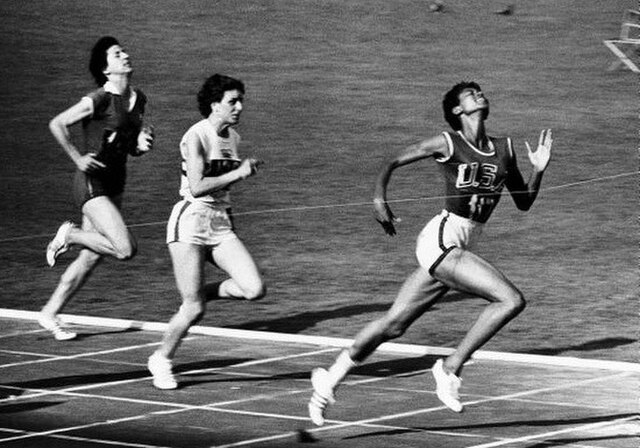
Imagine being told as a child that you might never walk, and then becoming the fastest woman on Earth. That’s not a metaphor. That’s Wilma Rudolph.
Born into poverty, hit with polio, scarlet fever, and pneumonia before she turned five, she spent much of her early life in a leg brace. Doctors told her family she might not ever stand unaided.
She didn’t just walk. She ran. And then she flew.
By the time she was 20, she had three Olympic gold medals and the world at her feet.
A Childhood No One Would Envy
Wilma was born in 1940 in Saint Bethlehem, Tennessee, as the 20th of 22 children. Yes, you read that right. Twenty-two children. Her father, Ed, worked as a railroad porter and handyman. Her mother, Blanche, worked as a maid. Between them, they were raising what basically amounted to a small village.
Her family was Black, poor, and living in the segregated South, which meant access to basic healthcare was a constant fight. When polio paralyzed her left leg at age five, it was a near-death sentence for any dreams of athleticism.
Polio was terrifying in the 1940s. Before the Salk vaccine arrived in 1955, the disease swept through communities every summer, leaving thousands of children paralyzed or dead. For a poor Black family in rural Tennessee, the prognosis was even grimmer. Hospitals that treated Black patients were few and far between, often underfunded and overcrowded.
But Wilma’s mom, Blanche, didn’t accept that.
She drove her daughter to a hospital 50 miles away in Nashville, week after week, for therapy that would eventually help Wilma walk again. This wasn’t a quick drive down the interstate. In 1940s Tennessee, this meant hours on rough roads, burning precious gasoline and time the family could barely afford. Blanche made that journey twice a week for years.
At home, her siblings took turns massaging her leg, following the techniques the therapists had demonstrated. Four times a day, every day, someone in the Rudolph household was working on Wilma’s leg. It became a family mission. The brace came off when Wilma was 9. By 12, she was playing basketball.
By 14? She was sprinting.

The Basketball Court That Changed Everything
Wilma’s entry into sports wasn’t some calculated decision. It was pure determination mixed with a bit of sibling rivalry. Her older sister was on the basketball team at their high school, and Wilma was tired of watching from the sidelines.
So she started showing up to practice. And showing up. And showing up. The coach, Clinton Gray, eventually let her join the team just to stop her from pestering him. Turns out, that was a very good decision.
Wilma became a basketball star at Burt High School, scoring 803 points in 25 games during her sophomore year. That’s an average of 32 points per game in an era when girls’ basketball was still played with restrictive rules that limited movement and scoring opportunities.
But what really caught attention was her speed. On fast breaks, she was untouchable. Coach Gray noticed and mentioned her to a friend who coached track. That friend was Ed Temple from Tennessee State University.
Becoming a Bullet
Wilma wasn’t just fast. She was fast with something to prove. Her high school track coach noticed it immediately and got her a spot at a training camp run by Tennessee State University. There, she met Ed Temple, a coach who would change her life.
Temple ran the Tigerbelles, Tennessee State’s women’s track team, which was becoming legendary in its own right. He saw something in Wilma beyond raw speed. He saw discipline waiting to be shaped, potential that could be world-class if properly trained.
Temple’s training methods were rigorous and sometimes brutal. Summer training camps meant running in the oppressive Tennessee heat, practicing starts over and over until form became instinct, building the kind of explosive power needed to compete at the highest levels. For Wilma, who had spent years rebuilding strength in a leg that polio had tried to destroy, the training was especially demanding.
But she thrived on it. Every sprint, every drill, every painful training session was proof that she could do what doctors said was impossible. By the time she was 16, she wasn’t just keeping up with college athletes. She was beating them.
At 16, she qualified for the 1956 Olympics in Melbourne and came home with a bronze medal in the 4x100m relay. Not bad for a kid who had to be carried for most of her childhood.
But she wasn’t done. Not even close.
The Years Between: Building a Champion
Winning a medal at 16 is remarkable. But the four years between Melbourne and Rome were where Wilma transformed from a promising young sprinter into an unstoppable force.
She enrolled at Tennessee State on a track scholarship, becoming one of Temple’s full-time Tigerbelles. The training intensified. Temple was preparing his athletes not just to compete but to dominate. He studied European training methods, incorporated new techniques, and pushed his runners to their absolute limits.
Wilma also faced challenges beyond the track. In 1958, she became pregnant and had a daughter, Yolanda. In an era when this could have ended her athletic career and her education, Wilma refused to let it. Her family helped care for the baby while she continued training and attending classes. The determination that had gotten her out of leg braces now kept her on the track despite enormous personal and social pressure.
She also dealt with the constant ache of being exceptional in a world that didn’t always want to acknowledge it. As a Black woman athlete in the 1950s American South, she faced discrimination at every turn. Hotels that wouldn’t give her team rooms. Restaurants that wouldn’t serve them. Awards ceremonies where she had to enter through side doors.
But each slight, each insult, each closed door just made her run faster.
Rome, 1960: Where She Became a Legend
The 1960 Summer Olympics in Rome made Wilma Rudolph a household name. She didn’t just win races. She obliterated expectations.
She won gold in the 100m. Then the 200m. Then anchored the 4x100m relay to another gold. All in world-record time.
Let’s put this in perspective. The 100-meter dash is considered one of the most competitive events in track and field. Winning it once is a career-defining achievement. Wilma won it while also competing in two other events at the same Olympics, all while dealing with a twisted ankle she’d suffered during competition.
In the 200-meter final, she ran 24.0 seconds, tying the world record despite running into a headwind. Witnesses said she seemed to glide across the track, her stride so smooth it looked effortless. It wasn’t, of course. It was years of painful training and an iron will wrapped in grace.
The 4x100m relay was perhaps most dramatic. The U.S. team had a shaky baton pass, putting them behind. Wilma, running anchor, got the baton in third place. By the time she crossed the finish line, she’d blown past the competition. The crowd went wild.
She became the first American woman to win three gold medals in track and field at a single Olympics. The Italian media dubbed her “La Gazzella Nera” (The Black Gazelle). The French called her “La Perle Noire” (The Black Pearl).
America, still catching up, called her a hero.
Coming Home to a Divided Nation
Wilma returned from Rome to ticker-tape parades, television appearances, and national acclaim. She met President Kennedy. She appeared on the cover of major magazines. For a moment, she was everywhere.
But fame in 1960s America came with complications, especially for a Black woman from the South. Her hometown of Clarksville wanted to honor her with a parade and banquet. Wilma had one condition: it couldn’t be segregated.
This was a bold demand. Clarksville, like most Southern towns in 1960, maintained strict racial segregation. Public events were either for whites or for Blacks, never mixed. City officials initially balked. They’d never held an integrated event.
Wilma stood firm. Either everyone could celebrate together, or there would be no celebration at all.
The city relented. On October 4, 1960, Clarksville held its first integrated event, a banquet and parade celebrating Wilma Rudolph’s Olympic victories. Black and white residents sat together, ate together, celebrated together. It was a small crack in the segregated South, but it was real.
More Than Medals
Wilma’s victories weren’t just personal. They were political. In 1960, the U.S. was still deep in the civil rights struggle. Rosa Parks had refused to give up her bus seat just five years earlier. The Freedom Rides were about to begin. Schools were slowly, painfully desegregating.
Into this charged atmosphere came Wilma, a Black woman from the rural South who had conquered the world stage. She became a symbol, whether she wanted to be or not. Her success challenged racist assumptions about Black athletic ability being somehow “natural” rather than the product of discipline and training. Her grace and intelligence in interviews pushed back against stereotypes. Her insistence on integrated celebrations forced conversations about equality.
After retiring from track at just 22 (she wanted to go out on top, while she was still unbeaten), she became a teacher, coach, and global ambassador for women in sports. She taught second grade and coached track at her old high school. She traveled the world speaking about athletics and equality. She worked with Operation Champ, an inner-city sports program, helping disadvantaged youth discover their potential through athletics.
She spoke out against discrimination and worked with youth programs across the U.S. In 1977, she published her autobiography, and later a TV movie about her life introduced her story to a new generation. She served on presidential advisory boards and worked with organizations promoting women’s rights and civil rights.
She never stopped running toward something better.
The Cost of Being First
For all her achievements, Wilma never became wealthy. Olympic athletes in that era received no prize money. Endorsement deals for Black female athletes were virtually nonexistent. While male Olympians parlayed their medals into lucrative careers, Wilma returned to Tennessee and a teacher’s salary.
She struggled at times financially. Her first marriage ended in divorce. Raising four children while working and maintaining her public role was exhausting. The same media that had celebrated her in 1960 moved on to new stories, new athletes, new heroes.
But she never seemed bitter about it. In interviews, she focused on what she’d been able to accomplish, the doors she’d opened for others, the young athletes who told her she’d inspired them. That seemed to matter more to her than the money she never made or the recognition that faded.
What She Left Behind
Wilma died of brain cancer in 1994 at just 54. Way too soon. But by then, she’d already reshaped what was possible.
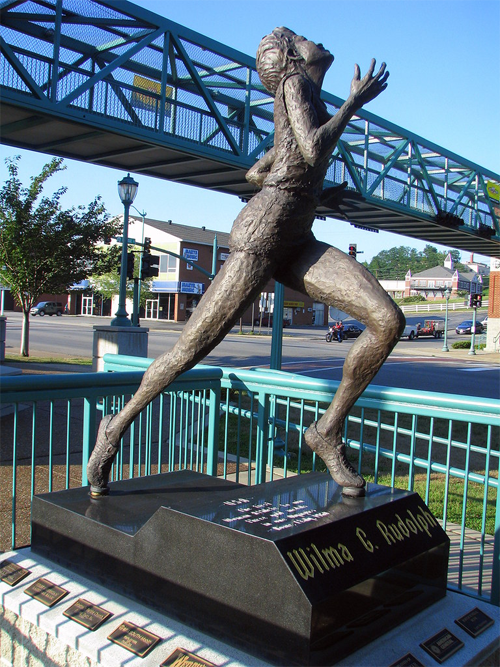
She was inducted into the U.S. Olympic Hall of Fame in 1983. There’s a statue of her in Clarksville, standing tall in bronze, forever mid-stride. A school is named after her. Her story is still taught in classrooms and shouted in sports documentaries. The Wilma Rudolph Event Center at Tennessee State University ensures her name remains part of the institution that helped make her great.
But more than that, she left behind a blueprint. For grit. For grace. For defiance.
She showed that physical limitations don’t have to define you. That poverty doesn’t determine destiny. That being told you can’t is sometimes the best motivation to prove you absolutely can. She demonstrated that excellence can be a form of protest, that winning with dignity can change minds, that representation matters because seeing someone who looks like you succeed makes your own dreams feel possible.
Athletes who came after her, from Jackie Joyner-Kersee to Florence Griffith-Joyner to Allyson Felix, have all acknowledged the path Wilma blazed. Without her, their journeys would have been harder, the barriers higher, the skepticism more intense.
The Polio Epidemic Context
It’s worth understanding just how terrifying polio was in Wilma’s childhood. Between 1916 and 1955, polio epidemics swept through the United States regularly, peaking in the early 1950s with over 20,000 cases annually. The disease primarily affected children, causing paralysis that was often permanent.
Parents lived in fear during summer months when outbreaks typically occurred. Public pools and movie theaters closed. Children were kept indoors. The iron lung, a mechanical respirator for those whose breathing was paralyzed, became a symbol of the disease’s devastating impact.
For a Black family in rural Tennessee, the challenges were even more severe. Access to iron lungs was limited. Physical therapy was often unavailable. The medical establishment provided far fewer resources to Black communities. That Wilma recovered at all, much less went on to become an elite athlete, was extraordinary not just because of her willpower but because her family fought for treatment most families in their situation never received.
When the Salk vaccine was introduced in 1955, it was hailed as a miracle. Wilma was already 15 by then, her battle with polio long over. But she became, in a way, a symbol of what could be overcome even before the vaccine existed, a reminder that human determination could sometimes defeat even the most feared diseases.
Final Thoughts: Running Past the Odds
Wilma Rudolph was told she might never walk. She became a symbol of speed. But more than her gold medals or record times, it’s her journey that hits hardest.
Because who among us hasn’t been told we can’t?
Maybe it wasn’t polio. Maybe it was something else. A learning disability. A financial setback. A family crisis. A system designed to keep us out. Whatever it was, we’ve all faced moments when success seemed impossible, when the smart money was on us failing, when giving up would have been easier than pushing forward.
Wilma’s story reminds us that limitations are sometimes just invitations to fight harder. That a broken body doesn’t mean a broken spirit. That sometimes, the most beautiful races are the ones no one expects us to run.
She also reminds us that we don’t do it alone. Behind Wilma was a mother who drove for hours twice a week for years. Siblings who massaged her leg four times daily. Coaches who saw potential and refused to let it waste. A community that rallied around one girl’s impossible dream.
Success stories like Wilma’s aren’t just about individual brilliance. They’re about what becomes possible when determination meets opportunity, when talent finds training, when someone who could have been written off finds people who refuse to give up on them.
So yeah, she ran. Right into history. And she did it with such grace, such power, such absolute refusal to accept limitations that she changed what we all believed was possible.
The girl who couldn’t walk became the woman who flew. And in doing so, she showed us all how to run toward our own impossible dreams.
Sources:
1. Olympics.com: Wilma Rudolph Biography
2. NPR: Remembering Wilma Rudolph
3. Tennessee Encyclopedia: Wilma Rudolph