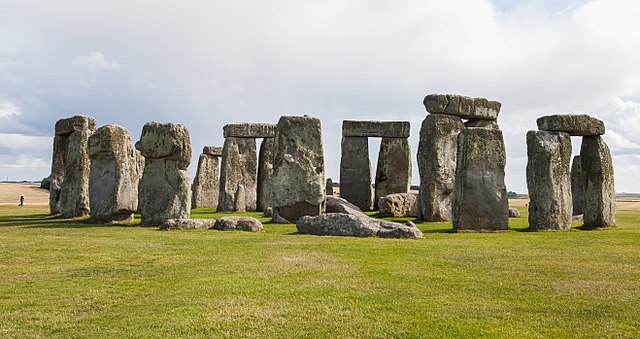
It was a drizzly September morning in 1915 when a man named Cecil Chubb casually wandered into an auction house in Salisbury, England. His wife, Mary, had a very specific request: he was to bid on a set of dining room chairs, or perhaps some new curtains, to spruce up their home.
He came back with Stonehenge.
Yes, the Stonehenge. The 5,000-year-old Neolithic henge, a prehistoric circle of stones steeped in mystery, astronomical alignment, and Druidic legend. This wasn’t a Monty Python sketch or a grand cinematic plot. It was a strange, impulsive act by an unassuming barrister from Wiltshire that would fundamentally alter the trajectory of one of the world’s most significant historical landmarks.
Seriously, Who Sells a Wonder of the Ancient World?
To understand how a private citizen could simply “buy” a global icon, you have to realize that in 1915, Stonehenge wasn’t the protected UNESCO World Heritage site we know today. It was essentially an inconveniently placed pile of rocks in the middle of a Salisbury Plain farm.
For centuries, the monument had been passed around between private landowners like a family heirloom that nobody really wanted to dust. At the time, it was owned by the Antrobus family. However, the heir to the estate, Lieutenant Edmund Antrobus, was tragically killed in the early months of World War I. With the lineage broken and the estate facing mounting taxes, the family decided to liquidate their holdings.
So, Stonehenge went up for sale as Lot 15 in a routine local auction. The catalog description was remarkably dry, offering the monument and the surrounding 30 acres of land. At the time, the site was in a state of pathetic neglect. It was more of a local hangout spot than a heritage site. Tourists—who were few and far between—frequently chipped off pieces of the bluestones to keep as souvenirs, and local teenagers were known to carve their initials into the ancient sarsen monoliths.
The Auction: A Very Surprised Crowd
When the auctioneer opened the bidding at £5,000 (roughly £600,000 in today’s currency), the room was reportedly quiet. It was the height of the Great War; most people were worried about rations and the front lines, not the ownership of a crumbling stone circle.
Cecil Chubb wasn’t even planning to bid. He was a successful lawyer and a local boy who had grown up in the nearby village of Shrewton. According to legend—and Cecil’s own chuckling retellings later in life—he felt a sudden, patriotic pang. He didn’t like the idea of a wealthy American collector or a foreign speculator buying a piece of English history.
As the bidding stalled, Cecil raised his hand. A brief bidding war broke out, but Cecil was determined. He placed the winning bid of £6,600. In modern terms, that is roughly the price of a modest three-bedroom house in a quiet suburb. Imagine picking up the Great Pyramid because it happened to be listed on Facebook Marketplace. That was the energy in the room when the gavel fell.
The “Curtains” Conversation: A Domestic Disaster?
One can only imagine the conversation when Cecil returned home that evening.
“Did you get the curtains, Cecil?” “No, dear. But I did buy a prehistoric temple.”
While history doesn’t record Mary Chubb’s exact reaction, local lore suggests she was less than thrilled. The purchase was a massive financial commitment for a whim, and it didn’t exactly solve their interior decorating needs. However, the “accidental” nature of the purchase began to settle into a sense of duty. Cecil realized that he wasn’t just a landowner; he was a gatekeeper.
From Private Oddity to Public Treasure
At first, the public was skeptical. People wondered if Chubb would charge exorbitant entry fees, build a summer home in the center of the Altar Stone, or perhaps even move the stones to his own backyard.
But Cecil Chubb was a man of surprisingly modern sensibilities. He saw the way the site was being mistreated. He saw the lean-to wooden props holding up the massive lintels and the litter left by picnickers. He realized that no single person should “own” Stonehenge.
Three years later, in 1918, he did something extraordinary. He wrote a letter to the Commissioner of Works and gifted Stonehenge to the British nation. But he didn’t just hand over the keys; he included a set of “Common Sense” clauses that still influence how the site is managed today:
-
Public Access: The public must always be allowed to visit for a “reasonable” fee (at the time, he specified it should not exceed one shilling).
-
Preservation: The site must be maintained in its historic state.
-
Local Rights: He famously stipulated that residents of the local area should be allowed to visit for free—a right that locals still fight to maintain to this day.
The Restoration You Never Knew Happened
Thanks to Chubb’s donation, the British government finally had the authority to step in. What most visitors today don’t realize is that Stonehenge is partly a 20th-century restoration project.
In 1919, the Office of Works began a massive engineering undertaking. Several of the stones were straightened and set in concrete to prevent them from falling. During the 1920s and 1950s, more stones were re-erected using cranes and modern surveying equipment.
This was incredibly controversial at the time. Purists argued that the government was creating “fake history” or a “Disney-fied” version of the Neolithic era. They believed the stones should be left to fall naturally as a testament to the passage of time. However, the engineers argued that without these supports, the entire inner trilithon would have collapsed within fifty years. Because of Cecil Chubb’s gift, we have a monument that is structurally sound enough to be studied by modern archaeologists.
The Mystery of the “Man Who Bought the Rocks”
Why isn’t Cecil Chubb a household name? It’s a great question. In an era of “branding” and “influencers,” Chubb’s humility is jarring. He didn’t ask for a statue. He didn’t ask for his name to be carved into the stones. He just did what he felt was right for the community and the country.
He was eventually knighted for his generosity, becoming Sir Cecil Chubb, First Baronet of Stonehenge. But beyond that, he quietly slipped back into his life as a barrister. He died in 1934, having seen his “impulse buy” become the crown jewel of British heritage.
The Accidental Hero We Didn’t Know We Needed
Stonehenge has stood for five millennia. It has survived the Roman occupation, the Middle Ages, and the Industrial Revolution. But the reason it survived the 20th century—an era of rapid urban development and souvenir-hunting—is because of a man in a tweed coat who decided to improvise at a local auction.
In our modern world, where everything is monetized and every gesture is calculated for maximum social media impact, Cecil Chubb’s story hits differently. He didn’t just save a pile of sarsen stones; he saved a story, a mystery, and a piece of our collective human DNA.
The next time you see a photo of the sun rising over the Heel Stone during the summer solstice, spare a thought for Cecil. He went out for curtains and ended up giving the world its most famous link to the stars.
Sources:
1. English Heritage: The Sale of Stonehenge
2. Pitts, Mike. Hengeworld. Random House
3. The Guardian: The Man Who Bought Stonehenge https://www.theguardian.com/uk-news/2015/sep/20/the-man-who-bought-stonehenge-cecil-chubb-auction