He Pointed a Fake Mustache at a Dictator, and the World Laughed (and Listened)
It’s 1940. Hitler is marching across Europe, the world is teetering on the edge of chaos, and a silent film star with a bowler hat and toothbrush mustache is about to deliver one of the most powerful speeches in cinema history.
No, not a politician. Not a general. Charlie freaking Chaplin.
Chaplin, the king of slapstick, the man who made the world giggle through the Great Depression, stood up and threw a cinematic pie in the face of fascism. And somehow, the joke still echoes.
From Tramp to Truth Teller: A Journey in Black and White
Charlie Chaplin was never supposed to be a revolutionary. He was born dirt-poor in London in 1889, shuffled between workhouses and stages, abandoned by his father, and left to fend for himself when his mother succumbed to mental illness. The grim realities of Victorian poverty shaped everything about him. He knew hunger, humiliation, and the cruelty of institutions designed to warehouse the unwanted.
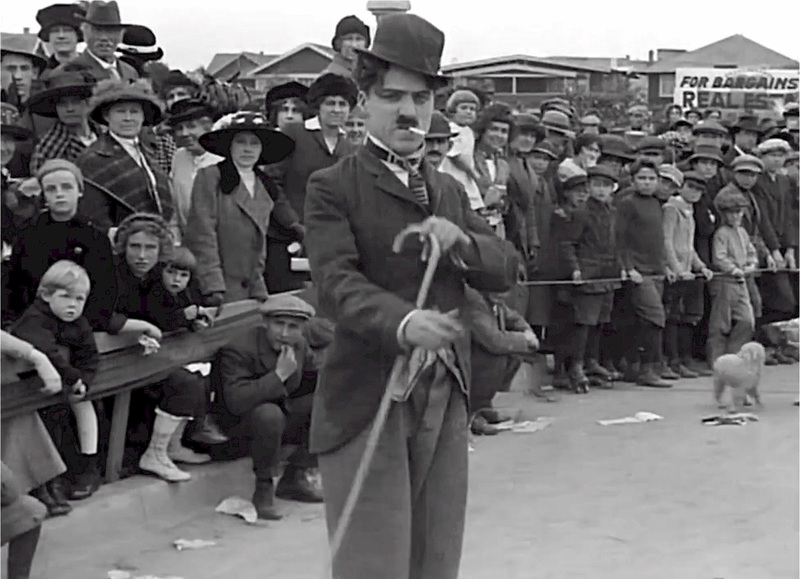
Out of that chaos came The Tramp: a sweet, awkward underdog with big shoes, bigger dreams, and a knack for making misery look kind of adorable. The character was a masterpiece of physical comedy, a walking contradiction who somehow maintained dignity while being kicked around by life. He wore a tight coat and baggy pants, carried a bamboo cane, and waddled through scenes with the grace of a ballet dancer trapped in a clown’s body.
That character became Chaplin’s ticket to global stardom. By the 1920s, he was arguably the most famous person on the planet. People who had never seen a movie knew who Charlie Chaplin was. His films crossed language barriers because they didn’t need words. A pratfall in America got the same laugh in Japan, France, or Brazil.
But with the rise of fascism in the 1930s, something shifted. Chaplin was no longer content to just entertain. He had always been political in subtle ways, showing sympathy for workers and the poor in films like Modern Times and City Lights. But this was different. The world was changing, and Chaplin felt compelled to change with it.
Chaplin saw through the spectacle. The uniforms. The goose-stepping. The charismatic cruelty. The way Hitler used pageantry and spectacle to sell hate. And he decided to mock it.

The Mustache That Changed Everything
There’s a strange historical quirk worth noting: Charlie Chaplin and Adolf Hitler were born just four days apart in April 1889. They both wore the same style of mustache. They both understood the power of image and spectacle. One used it to bring joy. The other used it to spread terror.
When Chaplin looked at Hitler, he saw a dark mirror. Here was a man who had weaponized performance, who had turned rallies into theater and politics into propaganda. Hitler understood timing, knew how to work a crowd, and used his physicality to project power. In another life, he might have been an actor. Instead, he became a monster.
Chaplin couldn’t ignore the resemblance. More importantly, he couldn’t ignore what Hitler represented. By the late 1930s, the Nazi regime had already stripped Jews of their rights, established concentration camps, and made clear its intentions for conquest. While many in Hollywood remained silent or cautious, Chaplin decided to act.
The Great Dictator: A Risky Satire Before the Bombs Dropped
Chaplin started filming The Great Dictator in 1939, before the U.S. had even entered World War II. It was gutsy, to say the least. Here was a man known for being silent, suddenly speaking out in the loudest way possible: lampooning Adolf Hitler while the real guy was still very much in power and controlling most of Europe.
The timing was crucial. In 1939, America was deeply isolationist. Many wanted nothing to do with European conflicts. There were even Nazi sympathizers within the United States, including prominent businessmen and politicians who saw Hitler as a bulwark against communism. Making a film that openly mocked the Führer was not just brave, it was commercially risky and politically dangerous.
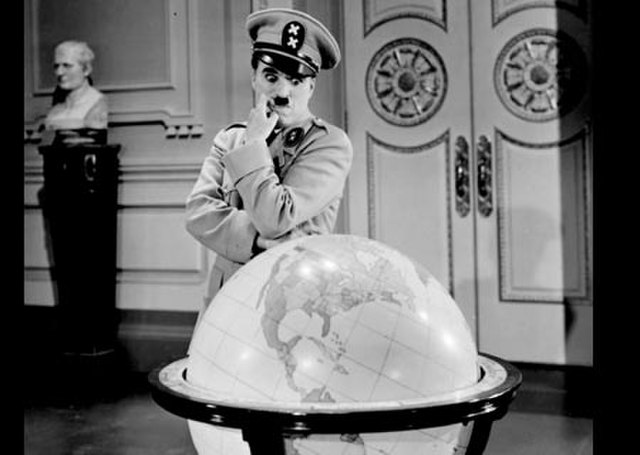
The film followed two characters, both played by Chaplin: Adenoid Hynkel, a buffoonish parody of Hitler who ruled the fictional nation of Tomainia, and a humble Jewish barber caught in the horrors of Hynkel’s regime. The dual role let Chaplin explore both the absurdity of fascist leaders and the humanity of their victims.
Hynkel was ridiculous, a screaming manchild who threw tantrums and spoke in gibberish that sounded like German but meant nothing. In one famous scene, he dances with a balloon globe, bouncing it dreamily in the air, fantasizing about world domination. It’s beautiful and terrifying at once. The balloon pops. The dream ends. The metaphor lands.
But the Jewish barber was where Chaplin’s heart lived. This character was essentially The Tramp transplanted into a nightmare, trying to maintain humanity in an increasingly inhumane world. Through him, Chaplin showed what fascism meant for ordinary people: the fear, the confusion, the desperate attempts to survive.
The production itself was an act of defiance. Chaplin financed the film himself, investing over two million dollars of his own money. Studios were nervous. Distributors worried about backlash. The British government initially banned the film, fearing it would offend Hitler and provoke retaliation. It took direct intervention and the changing tide of war for the ban to be lifted.
That Speech: When Comedy Became Prophecy
That ending speech? It still gives people chills. After 120 minutes of satire and slapstick, Chaplin breaks character completely. The Jewish barber, mistaken for Hynkel, is thrust in front of microphones to address the nation. And suddenly, it’s not the barber speaking. It’s not even really Chaplin. It’s something else entirely, a voice of conscience cutting through the fourth wall.
“We want to live by each other’s happiness, not by each other’s misery,” he pleads directly to the camera. “Don’t give yourselves to brutes, men who despise you, enslave you, who regiment your lives, tell you what to do, what to think and what to feel! You are not machines! You are not cattle! You are men!”
He wasn’t joking anymore. For six minutes, Chaplin abandons all pretense of entertainment and delivers a sermon on humanity, democracy, and hope. He calls for kindness, for reason, for people to reject the dehumanization that fascism demands. It’s earnest in a way that modern cynicism might find embarrassing, but in 1940, with Europe burning, it was exactly what needed to be said.
Some critics at the time felt the speech was too preachy, that it broke the film’s tone. Chaplin himself later said that if he had known the true extent of the Nazi death camps, he wouldn’t have been able to make the film at all, that the horror was too great for satire. But he didn’t know. None of them really knew. So he made a comedy with a conscience, and it became something more.
He Was Mocked, Investigated, and Eventually Exiled
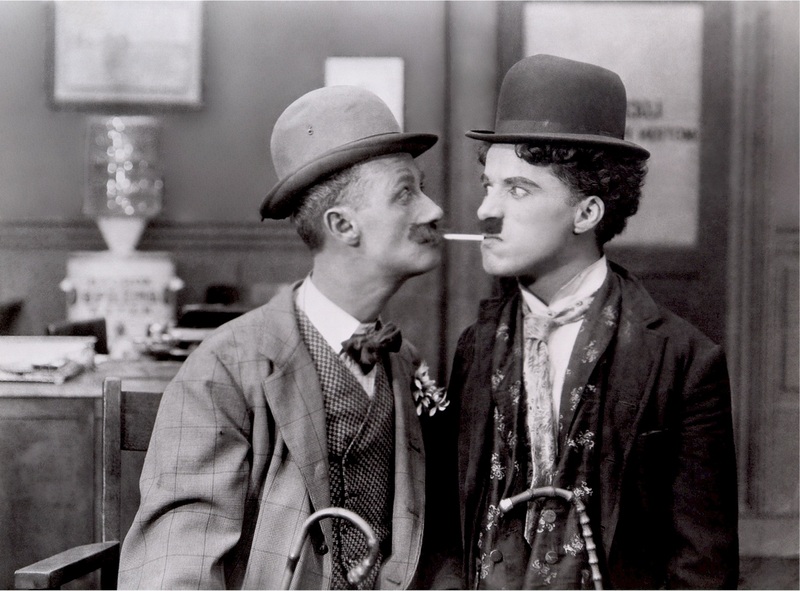
Chaplin paid a price for his boldness. He was accused of being a communist sympathizer, though he never joined any political party. J. Edgar Hoover, the FBI director who saw conspiracies everywhere, launched an extensive file on him. The surveillance lasted for decades. They investigated his finances, his relationships, his political statements. They wanted something, anything, to use against him.
The accusations intensified during the Red Scare of the late 1940s and early 1950s. Hollywood was being purged of anyone with leftist sympathies. Chaplin, with his outspoken views on social justice and his friendships with known socialists, became a target. It didn’t help that he refused to become an American citizen despite living in the U.S. for decades. He was British, stubbornly so, and saw no reason to pledge allegiance to a country that was increasingly hostile to him.
The final blow came in 1952. Chaplin was traveling to London for the premiere of his film Limelight when the U.S. Attorney General revoked his re-entry permit. He would need to face a hearing about his political views and moral character before being allowed back. Chaplin, tired and disgusted, decided not to return at all. He settled in Switzerland with his wife Oona and their children, and stayed there for the rest of his life.
The man who made America laugh was no longer welcome. It was a bitter irony that the country built on free speech had exiled one of its greatest artists for exercising that very right.
But history had already sided with him. The Great Dictator would become one of the most important films of the 20th century, studied in classrooms, referenced in documentaries, and recognized as a turning point in political cinema.
A Global Impact That Transcended Entertainment
When The Great Dictator premiered in October 1940, it had an enormous impact. The film was an instant success, both critically and commercially. Despite the controversy, or perhaps because of it, audiences packed theaters. It became one of the highest-grossing films of the year, proving that people were hungry for art that took a stand.
The anti-Nazi message resonated deeply with audiences living through the uncertainty of a world at war. In Britain, where the Blitz was raining bombs on civilians, the film gave people a way to laugh at their tormentors. In occupied countries, where screenings were forbidden, bootleg copies circulated in secret, watched in basements and backrooms as acts of resistance.
In a time when many were still unsure of how to respond to the rise of fascism, when appeasement was still considered a reasonable strategy by some, Chaplin’s film became a rallying cry. It gave people the courage to speak out against tyranny and injustice in ways they hadn’t before. It said clearly what many were afraid to say: that Hitler was not just wrong, but ridiculous. That fascism was not just evil, but absurd.
Chaplin’s decision to make the film, to take such a huge financial and personal risk, wasn’t just a cinematic triumph. It was a statement of defiance against everything that Hitler stood for. He put his reputation, his fortune, and potentially his safety on the line because he believed art had a responsibility to confront evil.
Legacy: The Laugh Heard Around the World
Today, Chaplin is often remembered as a mime with a cane, a quaint relic of cinema’s early days. But that’s just the surface. He was also a rebel, a social critic, and a truth-teller wrapped in comedy. Like all great comedians, he saw hypocrisy and called it out with a grin. He understood that laughter could be radical, that mockery could be a form of resistance.
His influence is everywhere: in satirical news shows that skewer political leaders, in political cartoons that reduce tyrants to caricatures, in the guts of artists who dare to mock power. Directors like Stanley Kubrick, Terry Gilliam, and Wes Anderson have all cited Chaplin as an influence, drawn to his ability to blend comedy with social commentary.
And that speech? It’s gone viral more times than we can count. It resurfaces during every political crisis, every moment when humanity seems to be slipping away. People share it on social media, clip it for documentaries, quote it in protests. The words feel as urgent now as they did in 1940, maybe more so.
What We Take From All This
Chaplin didn’t stop tyranny with jokes. Let’s be clear about that. The Great Dictator didn’t prevent World War II or save lives from the Holocaust. Hitler continued his rampage until military force stopped him. But Chaplin cracked fascism’s facade. He refused to let it maintain its dignity, its pretense of grandeur.
He made people laugh when it felt like the world was breaking. He reminded us that mockery is a kind of weapon, that dictators fear ridicule as much as they fear armies. Because once people start laughing at a tyrant, the spell breaks. The aura of invincibility fades. They become what they always were: small, insecure men playing dress-up with other people’s lives.
Chaplin showed that dignity, humor, and humanity can still shine even in the darkest times. That’s not nothing. In fact, that might be everything. Because culture shapes consciousness, and consciousness shapes action. The Great Dictator helped millions of people see fascism clearly, not as a force of nature but as a choice, something that could be opposed and defeated.
And maybe that’s the point. In a time when speaking truth can be dangerous, when autocrats are rising again in various corners of the world, when democracy feels fragile, it helps to remember that a guy in clown shoes once stood on a soundstage, shook his fist at fascism, and made history.
Chaplin proved that artists have power, that comedy isn’t just escape but can be confrontation, that sometimes the bravest thing you can do is make people laugh at what they’ve been taught to fear. He used his platform when it mattered most, consequences be damned.
That’s the legacy worth remembering: not just the films, not just the iconic image, but the courage to stand up and speak out when silence would have been easier and safer. Chaplin chose to fight with the only weapons he had, a camera and a conscience, and somehow, improbably, it worked.
The Great Dictator remains a testament to the power of art to challenge authority, to comfort the afflicted and afflict the comfortable, to remind us what we’re fighting for when everything seems lost. In the end, Chaplin’s greatest gift wasn’t making us laugh. It was making us believe that laughter itself could be an act of resistance, a declaration of our shared humanity in the face of those who would deny it.
And in these times, when the world once again feels uncertain and authoritarian impulses are stirring, maybe we need that reminder more than ever.
Sources:
1. Chaplin, Charles. My Autobiography. Simon & Schuster
2. Maland, Charles. Chaplin and American Culture. Princeton University Press
3. The Great Dictator (1940), Full Speech Clip https://www.youtube.com/watch?v=J7GY1Xg6X20
4. FBI Records on Charlie Chaplin, FBI Vault