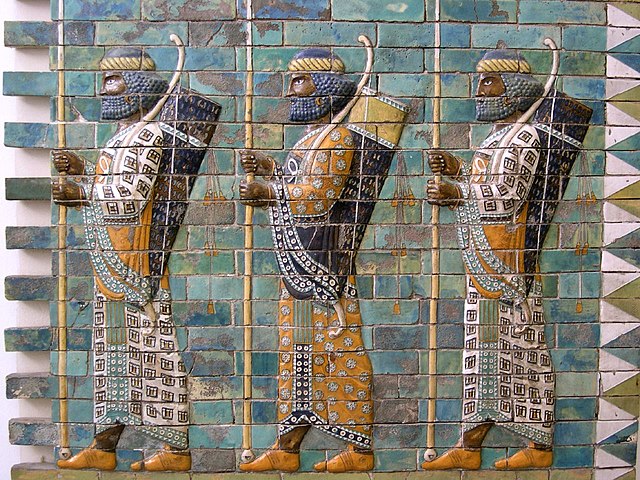
Why Ancient Persian Warriors Wore High Heels
Why Ancient Persian Warriors Wore High Heels
If your image of high heels involves red carpets, runways, or maybe an overpriced brunch in Soho, it’s time to rethink things. Because the first people to rock heels? Persian horse archers. And they did it to kill more efficiently.
Blood, Bows, and Heels
Let me take you back to the 10th century. You’re galloping across the Iranian plateau, wind howling past your ears, bow drawn tight, scanning the horizon for enemies. Your horse is moving at full speed. You need to twist in the saddle, aim behind you, and release an arrow while maintaining perfect balance. And what’s keeping your feet locked into those stirrups during a high-speed turn? A heel. A small, sturdy one, made of leather or wood, maybe an inch or two tall.
Persian cavalry needed something that would anchor their feet during battle. These were warriors, not catwalk models. They weren’t strutting down palace corridors. They were shooting arrows while riding at full speed, executing the devastating Parthian shot, the legendary technique of turning backward in the saddle to fire at pursuing enemies.
A raised heel gave them better leverage in the stirrups, letting them stand up slightly and shoot with deadly accuracy. The heel hooked into the stirrup, creating a stable platform that transferred the horse’s power through the rider’s legs. This wasn’t just convenient. It was the difference between hitting your target and getting killed.
It wasn’t fashion. It was function. High heels were born in blood and dust, not boutiques.
The Persian cavalry was legendary for a reason. They were some of the most feared warriors of the medieval period, capable of sustained archery while mounted, something that required extraordinary skill and the right equipment. The heel was part of an entire system of riding technology that included specialized saddles, stirrups, and bows designed for mounted combat.
These weren’t delicate shoes. They were practical, durable boots with reinforced heels, often decorated with metalwork or embossing that indicated rank and unit. A warrior’s boots told a story about who he was, where he came from, and how many battles he’d survived.
The Look That Conquered Europe
Eventually, Persian culture made its way into Europe, especially during the 17th century. This wasn’t just about shoes. It was part of a broader fascination with “Oriental” luxury and sophistication that swept through European courts. Travelers, diplomats, and merchants brought back tales of Persian splendor, along with actual Persian goods: carpets, textiles, and yes, riding boots with heels.
European aristocrats, always looking for ways to peacock their power and distinguish themselves from commoners, saw Persian heels and thought: Yes, this is exactly the kind of impractical detail we can use to show off our wealth. If you can barely walk in your shoes, it means you’re rich enough not to need to work. You have servants to carry you, horses to ride, and no fields to plow.
The military functionality was quickly abandoned. European nobles weren’t fighting from horseback the way Persian cavalry did. They were attending court, hosting banquets, and parading through palace halls. The heel became pure status symbol, divorced from its practical origins.
Louis XIV of France took this to a royal extreme. The Sun King, obsessed with spectacle and hierarchy, wore red-heeled shoes as a status symbol starting in the 1670s. The heels weren’t just red. They were painted in a specific shade of red, created from expensive dyes. And here’s the key part: only people in his court, only those he specifically approved, could wear them.
If your heels were red, you weren’t just stylish. You were powerful. You had royal favor. You belonged to an elite inner circle. Violating this dress code could get you banned from court, which in Louis XIV’s France was social death. Honestly, it was more exclusive than any luxury brand today. No amount of money could buy you red heels if the king didn’t approve.
Louis XIV was reportedly only 5’4″, and his heels, which could be up to five inches tall, helped him literally look down on his courtiers. Every aspect of his appearance was calculated for maximum symbolic power. So yes, Persian horse archers indirectly helped invent the idea of designer shoes and the entire concept of fashion as exclusivity.

Masculinity, Remixed
Here’s the fun part: high heels didn’t start as women’s fashion. For centuries, they were all about military prowess and elite male fashion. Portraits from the 17th and 18th centuries show European men in elaborate heeled shoes, stockings, and often more decorative clothing than their female counterparts.
It wasn’t until the 18th century that women started adopting the style and reshaping its meaning. Initially, this was part of a broader trend of women borrowing elements of men’s fashion to signal power and independence. Women who wore heels in the early 1700s were often making a statement about their status and authority.
But then something interesting happened. As women embraced heels, men gradually abandoned them. By the end of the 18th century, men’s fashion was moving toward practicality and restraint. The Enlightenment and then the French Revolution brought new ideals about masculine simplicity and rationality. Heels, along with wigs, makeup, and elaborate clothing, came to be seen as frivolous.
Men eventually dropped them, possibly because once something becomes associated with women in patriarchal societies, it magically stops being seen as powerful. This is a pattern that repeats throughout fashion history. As soon as women adopt something, it gets reframed from “powerful” to “decorative” or “sexual.”
So the next time someone snickers at a guy in heels or suggests they’re not “manly,” maybe remind them that heels were originally a weapon of war. Literally. The most masculine thing imaginable: cavalry warfare. Genghis Khan’s horsemen probably wore them. Persian warriors who conquered vast territories wore them. They’re about as traditionally masculine as it gets.
From Battlefield to Boutique
By the time the 1800s rolled around, heels had become almost entirely a women’s fashion item in Europe and America. They got narrower, taller, and more decorative. They lost their military roots entirely and became associated with posture, femininity, sexuality, and yes, sometimes significant physical pain.
The Victorian era brought new heel styles that emphasized tiny feet and restricted movement, reflecting broader attitudes about women’s proper place in society. If your shoes made it hard to walk far or fast, that was considered appropriate. You weren’t supposed to be going anywhere alone anyway.
The 20th century saw heel heights and styles fluctuate with social changes. The 1920s flapper era brought lower, sturdier heels for women who wanted to dance. The post-WWII 1950s brought back extreme stilettos, those pencil-thin heels that required tremendous balance and quite literally restricted where women could walk (they weren’t allowed in many buildings because they damaged floors).
The stiletto heel, invented in the 1950s, could be five or six inches tall and narrow as a pencil at the base. It was technically advanced, requiring steel reinforcement to support a person’s weight on such a small point. It was also deliberately impractical, designed to create a specific aesthetic of femininity that prioritized appearance over function.
But it’s kind of wild to realize that stilettos have an ancestor in a Persian cavalry boot. One was made to stabilize your shot during a gallop, to help you kill enemies while maintaining perfect balance on a moving horse. The other? Mostly made to make you look taller in a club bathroom mirror, to change the shape of your legs, to signal sexual availability or high fashion depending on context.
Still, there’s a through-line: heels signal something. Power. Style. Status. Command of attention. The meaning has shifted, but the symbolic weight remains. Whether you’re a 17th-century French courtier or a modern CEO, heels announce that you matter, that you’re willing to endure discomfort for impact, that you understand the codes of power in your particular world.
The Modern Heel Renaissance
Today, heels are experiencing yet another cultural shift. More men are wearing them again, from musicians and performers to everyday fashion enthusiasts. Drag culture has kept heels alive in queer communities for decades, and that aesthetic is increasingly mainstream.
There’s also growing awareness of the health problems heels can cause: bunions, shortened Achilles tendons, back problems, nerve damage. Some women are rejecting them entirely. Others view them as occasional tools, weapons of professional or social warfare to be deployed strategically.
The conversation about heels has become explicitly political. Are they oppressive? Empowering? Both? Neither? Can something designed (in its modern form) to restrict women’s movement and cause pain ever be truly empowering, or is that just adaptation to oppression?
These are real questions without easy answers. What’s clear is that heels carry tremendous cultural weight far beyond their practical function. They’re about gender, power, sexuality, class, and identity.
Why It Still Matters
Knowing this history changes how you look at fashion. It reminds us that fashion isn’t shallow or frivolous. It’s layered with meaning. It carries stories of migration, war, identity, and reinvention. Every garment, every accessory has a past that often contradicts its present.
A heel isn’t just a heel. It’s a piece of armor transformed into ornament. It’s a social signal that’s shifted meaning across centuries and cultures. It’s sometimes a political statement, sometimes a source of confidence, sometimes a tool of oppression, sometimes all of these at once.
Understanding that high heels were invented by warriors fundamentally challenges modern assumptions about gender and fashion. It reveals how arbitrary our associations are. There’s nothing inherently feminine about heels. That’s a recent cultural invention, barely 200 years old, built on the ruins of a much longer history where heels meant something completely different.
So the next time you see someone strutting in heels, whether it’s a drag queen reclaiming masculine fashion history, a businessman making a statement, or your friend at brunch navigating cobblestones, remember: they’re walking in the footsteps of ancient warriors. They’re participating in a tradition that stretches back a millennium, that crossed continents and cultures, that was forged in battle and remade in ballrooms.
Every step in heels is a small act of defiance against gravity, practicality, and often pain. But it’s also a connection to history, to the Persian cavalry who first discovered that a little extra height could mean the difference between life and death. The context has changed. The courage it takes to walk in them? That’s remained surprisingly constant.
Sources:
1. Smithsonian Magazine – Origins of High Heels
2. Smithsonian Magazine – The First High Heels Were Designed For Men
3. Fashion History – High Heels